


Need assistance setting up new lighting config

Christopher Poore

Active Member
View Badges
Joined
Jan 18, 2016
Messages
339
Reaction score
70
Location
Boulder, CO
Rating - 0%
0   0   0
Hello all!

Tank Dimensions - 36x18x20
Due to mounting constraints the Hydra 52HD are 6.25inch above water, and the primes are 6.5inch above water

I made a recent move and went from 2 tanks (20gal tall & 57gal) into just the 57 gallon. I went ahead and purchased a Hydra 52HD to team up with my 2 AI Primes. Before the move, the 20gal was my primary tank and the 57 was simply cycling and getting ready to become my primary tank.

Originally the 20gal had 1 AI prime set to a max of 70% Blues, and something like 20% Whites. Everything including my SPS were doing amazing.

I currently have the lights on the new setup ramp up to a maximum of 35% blue/deep blue/royal blue. max of 5% green and max of 15% white. Lights are on for around an 10 hour cycle, including ramping and the whites are on for 6 hours max.
I have the 3 lights set up on MYAI to run together, but I could setup the Hydra, and the 2 primes separately to more evenly configure lighting spread?

Some coral are doing great while others are retracting quite a bit, and I'm under the assumption its primary due to the lighting. Any suggestions or should I just get the tank read by a par meter?
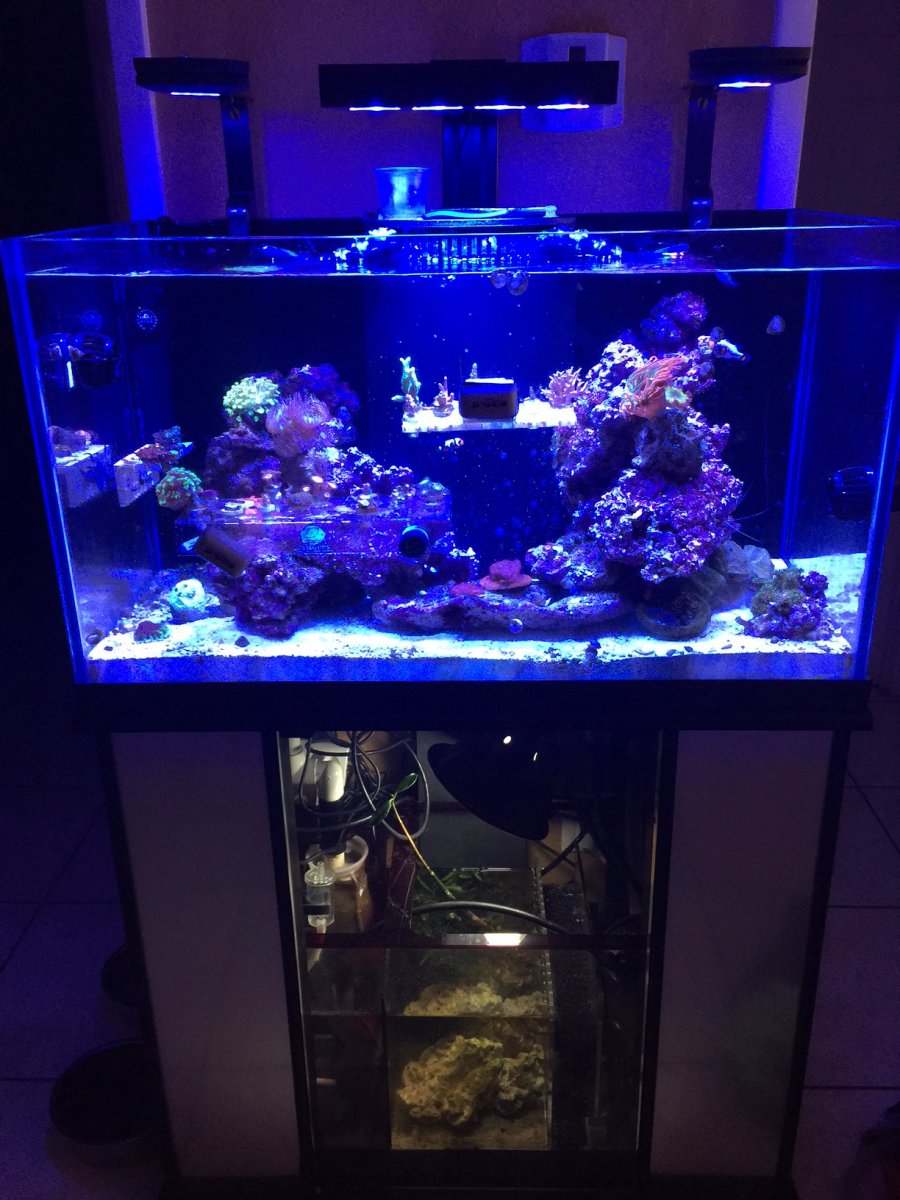
IMG_1709.JPG


IMG_1710.JPG
 
Last edited:

mcarroll

10K Club member
View Badges
Joined
Jan 8, 2012
Messages
15,213
Reaction score
8,968
Location
Virginia
Rating - 0%
0   0   0
If you can get a PAR meter, it'll be interesting to compare, but do not wait for that. :)

First, download a $free [HASHTAG]#lux[/HASHTAG] [HASHTAG]#meter[/HASHTAG] for your smartphone's camera and take some readings right now.

While the app is downloading, you should visit your favorite major reseller and pick up an "LX-1010B" handheld lux meter, or similar. Usually $15 (delivered) or less. Much better than the app and safer over saltwater!!
  • Measure your old settings on the Prime and find the peak measurement. (Measure at the same distance as where the old water level used to be.)
  • Try to replicate the same lux reading with your new lighting setup.
  • It's really as simple as that.
  • It could be handy to have the peak measurements to compare, as well as some readings around the perimeter.
  • If you want to make a light map, you could record all those measurements as well as where you get 50% of your peak reading.
Post your results back here though - sometimes the phone apps don't deliver correct results....a camera has a more sophisticated light meter, so some software voodoo is required to take readings like we need....and not all cameras seem to be recognized by all software.
 

NanoDJS

Valuable Member
View Badges
Joined
Apr 11, 2016
Messages
1,153
Reaction score
1,393
Location
NNJ /NYC
Rating - 0%
0   0   0
Nice tank and setup ! can I ask why so much light though ? It seems to be a new popular thing , but I am not understanding it, I will elaborate ... I guesstimate your par in most parts the that tank to be well above 500 including the sandbed I know the spectral output and lenses of those units , I run AI prime also , but mind you I run mine 12" off a 24x24x12 tank and get ridiculously happy corals from just 1 . After doing the hobby for a minute I would equate out 1 AI at 100% to a 250w HQI MH 12000k Its a dead ringer. also I shoot for 12,000k for 8 hours and 20,000k for 4 with rampup ect. the science is there and its been proven . Also people should be the best judge A natural reef has shadowing , diffusion and other things going on , its not an all angles lit halftime show . Basically your best 450nm spike of real par in those lights is in the Leds you keep the lowest , real 12,000k is the color of the sunlight as its about to enter tropic waters ,the water then splits it up and about 17500k hits your coral , the 20 k is just cooler to look at , the pros growing coral under what appears to be just blue light , are well pros and are doing more than most are picking up on with their blends of LEDs, semileds , hope that helps , keep it fragtastic and reef on !
 
Last edited:

OP
OP
Christopher Poore

Christopher Poore

Active Member
View Badges
Joined
Jan 18, 2016
Messages
339
Reaction score
70
Location
Boulder, CO
Rating - 0%
0   0   0
Thanks for the advice all! I have raised the Hydra to 11.5 inch off the water, and I will keep the primes at about 7 inches off the water.

I definitely want to get the tank read by a par meter. Again as of now the lights are at a Max of 35%. Even when they are ramping up to 35%, some coral that were originally much higher in the tank, are lower and retracted leading me to believe at 35% the par is still way too high.
 

mcarroll

10K Club member
View Badges
Joined
Jan 8, 2012
Messages
15,213
Reaction score
8,968
Location
Virginia
Rating - 0%
0   0   0
If you have a smartphone, check out one of the $free lux meter apps....."Galactica Luxmeter" is one people have had luck with on iPhone.

Let us know if you get some readings! (Don't wait on that PAR meter.) :)
 
OP
OP
Christopher Poore

Christopher Poore

Active Member
View Badges
Joined
Jan 18, 2016
Messages
339
Reaction score
70
Location
Boulder, CO
Rating - 0%
0   0   0
If you have a smartphone, check out one of the $free lux meter apps....."Galactica Luxmeter" is one people have had luck with on iPhone.

Let us know if you get some readings! (Don't wait on that PAR meter.) :)

Hello Macarroll! I found someone who is willing to do a par reading on my tank, but I will need to wait a week or so.

I have downloaded the lux app, where should i shoot the readings from? Each of the 4 corners of the tank as well as the center under the Hydra?
 

mcarroll

10K Club member
View Badges
Joined
Jan 8, 2012
Messages
15,213
Reaction score
8,968
Location
Virginia
Rating - 0%
0   0   0
Let's define some variables.
  • There's the peak reading, we'll call A.
    • There can be more than one peak.
    • A peak can be as small as one point, or a large area.
  • There's 90% of whatever that peak is, we'll call B.
  • Last, there's 50% of peak, which we'll call C.
    • If you don't get any reading over the tank that low, substitute some readings at the perimeter of the tank.)

Take all readings as close to the water surface as you can.

Angle the phone to get the maximum reading you can from each position you want to record.

The first time around, double check your results here to make sure the app is giving good readings.

If you can map out all three areas (A, B and C) on a piece of paper, you have a real light map for your tank.

Doesn't have to be more than 5 or 6 measurements, but you might want a more complete map than that. (Watch where the shadow of your "meter" falls - that's roughly the spot you are measuring at the surface. Target corals this way, if you want.)

Mostly, we're interested in comparing A from your old system with A from the new system so you can match the new to the old as closely as possible.

You should also order that handheld lux meter I mentioned so it gets there in time for the PAR meter. You can take parallel measurements with both meters and then you'll have the conversion factor to let you convert all future lux readings into PAR readings that are just as accurate as the PAR meter. Not bad for $15. :) :) :)
 

TOP 10 Trending Threads

WHAT AMOUNT OF LIVE ROCK AND SAND SHOULD BE PRIORITIZED FOR OPTIMAL BIODIVERSITY/FILTRATION?

  • 100% live rock + bagged sand

    Votes: 37 27.2%
  • 100% dry rock + 100% live sand

    Votes: 46 33.8%
  • 50/50 live/dry rock, 50/50 live/bagged sand

    Votes: 30 22.1%
  • 75% live rock, 25% live sand

    Votes: 13 9.6%
  • 25% live rock, 75% live sand

    Votes: 10 7.4%
Back
Top



