You people with this all blue must have completely different SPS than me... I'm running my warm whites at 50% on my photon v2 which gives by far the best color rendition of the nice stuff. Much less than that and it's just a washed out mess.
Here's a good example.. the first two pictures are like 100% blues and 30% warm white. The third is 100% blues and 100% warm white. You're really telling me that heavy blue is a better look?
Maybe all blue is a better look. Really depends on who is looking! FWIW I liked running pretty heavy whites on my RB photon v2 (2:1 blue white ratio) when I had mostly acros as to me it looked better and fish colors were visible. Now switching to LPS I run 0 white just some reds and blues because the LPS really look great to me under heavy blues and very quickly get washed out with white. The reds and greens do brighten up the tank a bit and there is no problem with color mixing as I have 2 photons over the cube covering the entire surface with LEDs.
But anyway it's totally subjective and again run what makes you happy and who cares what other people run since commercial vendors are running from 100% blues to quite white it's really not going to matter much compared to everything else we have to worry about in this hobby like flow and water chemistry.
Velcro, I'm running two Photon 32" V2's over a 150 gallon mixed reef tank and cant seem to find the sweet spot with these lights. (I have had these lights over this tank for over 1 1/2 years. Tank measusres 72"L x 18" W x 29"T.)
Would you mind sharing your lighting schedule and intensity.
Velcro, I'm running two Photon 32" V2's over a 150 gallon mixed reef tank and cant seem to find the sweet spot with these lights. (I have had these lights over this tank for over 1 1/2 years. Tank measusres 72"L x 18" W x 29"T.)
Would you mind sharing your lighting schedule and intensity.
Sure. I'm basically at 100% on royal blue, blue and violet and 50% on white, 20% red and green from 1pm-8pm. Outside that time I do a couple hours of just blues at like 30%.
Thank You.
Couple of more questions.
1.) How far off the surface of the waters are your lights?
2.) How long did it take you to get to this inensity level?
Thank You.
Couple of more questions.
1.) How far off the surface of the waters are your lights?
2.) How long did it take you to get to this inensity level?
I have them 18-20" above the water. I started the lights at around 50% blues and 20% whites. I basically bumped up the blues 10% every 1-2 weeks until 100% then I started bumping the whites up 10% every 1-2 weeks. When I started I was at around 175 par in the middle of the tank. I'm now are 325 par in the middle of the tank.
Blue looks nice but that is not what the actual ocean or reef environment is made of.
Those that do just blue i think because their corals looks bad and that is why they are using just blue so that their corals dont look very terrible when people come to see it.
Your LFS livestocks comes and goes so you dont know the long term success of your LFS livestocks
Ask them (or even yourself) to grow some sps with just blue light only for a year and see.
This isn't actually true. Depending on the depth of the coral, certain wavelengths of light is naturally filtered by the ocean. Red light is the first light to be filtered out as it has the weakest penetration factor. This is also why you can buy red tinted diving masks... At depths of as little as 50 feet a reef can look a lot like a tank without any white light.
Red light only gets to about 20 ft and green and blue is the only light that really penetrates to about 100 ft
It is common assumption that white light is made from Red, Green and Blue combined. But if we look at the colors of rainbow it consists of many spectrum from UV to deep red.
I am running more warmer spectrum for a few hours at 85% intensity and I am seeing more color pigmentation on corals. A lot of reefers hates warmer spectrum especially red and green simply because it will excite algae growing in reef tank.
O.M.G. People we learned this in grade 2. There are ONLY 3 colors. RED GREEN BLUE. That is it. Everything else is a combination of those three. SERIOSLY !
The thing that you guys are missing on this is that there are two different color scales.
So let's say your mixing paint using the standard color wheel we all learned about as kids. Red, blue and yellow creates black in the perfect mixture. Red and blue together make purple. Etc. This is called "subtractive color mixing"
Light sources work off of "additive color mixing" and it has the opposite effect of th subtractive color wheel. So RGB light sources combined creates white. It's not a trick though. The actual color that's created is white and it is the same white that a white LED would create.
I too prefer a whiter tank. I am running a Nanobox large retro at 85% RB, Cyan, Violet, and mint; with whites at 45%. I have two coral + t-5’s along side the led’s as well. This my midday setting that runs for 6 hours.
O.M.G. People we learned this in grade 2. There are ONLY 3 colors. RED GREEN BLUE. That is it. Everything else is a combination of those three. SERIOSLY !
Additive color is a result of the way the eye detects color, and is not a property of light. There is a vast difference between a pure spectral yellow light, with a wavelength of approximately 580 nm, and a mixture of red and green light. However, both stimulate our eyes in a similar manner, so we do not detect that difference, and both are yellow light to the human eye.
I´m using many different monochromic LED and create a whitish look with help of the RGB trick. That you can use the RGB trick is because of the construction of our eye´s. The human eye (read brain) does a calculation with help of the information coming in to these three main receptors in the eye. In the real world - there is photons of all colours you can see in the rainbow and by definition - white is a combination off all these photons with different wavelengths. The colours you seen in a fish are in 99 % reflecting colours but the reflecting pigments its not 100 % pure. It means that if certain wavelengths coming in they will be reflected in different ways. As an example adding a lot of blue - colours (as our eye´s (brain) see will fade away. I use a lot of red, orange and green diods together with mostly blue diods. I´ll get this result that you see in my photos. My yellow wrasse turns more to be orange and the beautiful colours of the Pyjamas show up. Lately - of different reasons - I have add two actinic T5 tubes - the result is that the colours of my wrasse turn mor yellow and the colours of the pyjama fade away a little.
i have cheap fluval marine and sea on my 29 gal standard. this thread had me thinking that while it has blue and red leds, it's dominated by white leds and if i am going to continue to add sps and other light deamnding corals into my mixed reef, perhaps i should rethink my lighting.
i have two sets of light with significant overlapping with each pumping out the following PAR according to fluval
376 @ depth of 3″ (76 mm)
222 @ depth of 6″ (15 cm)
90 @ depth of 12″ (30.5 cm)
47 @ depth of 18″ (46 cm)
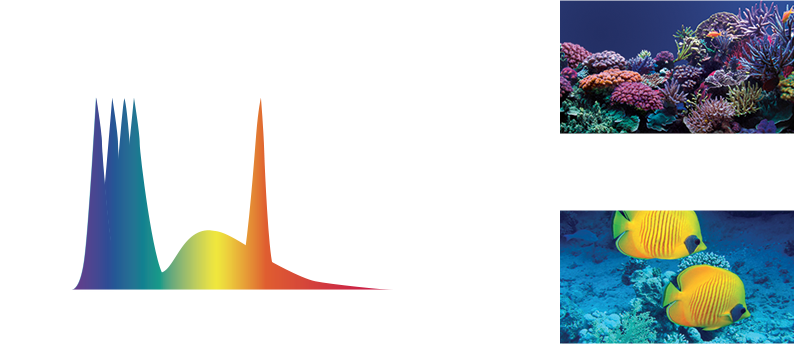
here is their blended wavelength
even though it's white led dominated, to me, the blended wavelength appears to have mitigated the imbalance of typical white LEDs, but i wold be very interested in opinions of more experienced people - would you consider these sufficient for more demanding corals? Assuming good water chemistry, would these encourage good growth and color?
edit note: the coral and fish are not mine, they are part fluval's posted picture of the wavelength so they made the trip to this post.