Warning - I have not tested the suggestions below. It can work but it can also cause problems. The alkatronic can only measure once every 2 hours as I understand - it means that the dose that will be set in one reading will last for 2 hours independent on how the KH develop during that time. The function I use in this example is constructed for probes that measure in a continuous mode. But it can work and maybe even for lesser testing periods than every 2 hours.
1 Calculate how many seconds it take for your actual (real) pump needs in order to dose 12 ml. If the calibration says 24 ml/minut - it means that 12 ml will take 30 seconds.
Look at this configuration of your pH 2. Nominal value - the KH you want to have - let us say you want 8.3 dKH as it is at the moment. Hysteris can be a critical part in my set up. You may change it by you need to test. As it stands now 0.30 - it means that below 8.15 you will have full output of your pulse (see below) - as it get closer to 8.3 - the pulse will be shorter and shorter with no pulse at all above 8.3 . Pulse ? Go down to Operation mode controller -
change it to pulse variable. Pulse should be your calculated time for 12 ml (or what your chose is) - in our example 30 sec. Pause should be the time between the different doses - in our example 10 minutes
Go down to Dynamic nominal value and change it to NO
It should look something like this. Note - the hysteris is rather critical - you may need to change - maybe to a lower value - 0.15 or lower. You have to test this. With lower value - harder response. Lowest possible value for Hysteris is 0.05 in pH - you may need to got down to this but I think that around 0.2 is enough.
TEST
Save and chose a "virtual" switch channel - I chose Switch channel index 63 for my example. Function pH 1 increase
Go to your actual Dose pump - the real physical pump - in my case dos pump 3. Pump to react on - Chose index 63
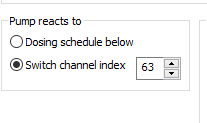
Now - what´s happen. I hope this following scenario will take place. When alkatronic report a dKH below 8.3 it will start the adjustable pulse program. It will do a pulse which length depends of how far away from the nominal value the reported value is - in this case -0.15 dKH mean full strength - 30 sec = 12 ml. Shorter deviation - less length of pulse and thus less dosed amount. After dose - it will wait 10 minute in order to see if something happens - if nothing change - a new pulse of the same strength - this will continue till the next reported measurements from alkatronic comes in - shortest period 2 hours. A new strength of the pulse will be in operation till next measurement and so on. If Alkatronic report a figure above the nominal value - there will be now pulse at all during the time to next measurement. Here I´m not sure if it is the actual nominal value or nominal value + 1/2 of the hysteresis that is the breaking point.
Once again Be careful if you test this solution
My suggestions is two different solutions and I can´t see that they are possible to combine. It one static and one partly dynamic. test them separately
The variable pulse function is a powerful tool - I use it for my heater.Max pulse 4 minutes and wait time before next pulse 30 sec. I use a short pause because heater and temp probe is in the same small apartment of the sump - it is a fast process
Because of limit function (till now) to monitor a switch channel I have configure a "virtual" pump for my heater. It has the calibration of 1 ml/min, react to the same switch channel as my heater and I record it. 1 ml in this chart means 1 minute of heater at on state !. Below - you can see how it react when I rise the nominal value from 25 to 25.5 degree C some day ago.
Without rising of nominal value - my temperature is rather stable
During a day with fall temperatures outside - the aquarium temperature only rise with 0.1 degree C during periods with full lighting (around 300 Watts LED). The chilling fans has not kicked in - the period with no heating is enough in order to withhold the temperature around 25.9 degree C)
Sincerely Lasse






















