The Wrasse Lover's Thread!

Image1518138348.783852.jpg

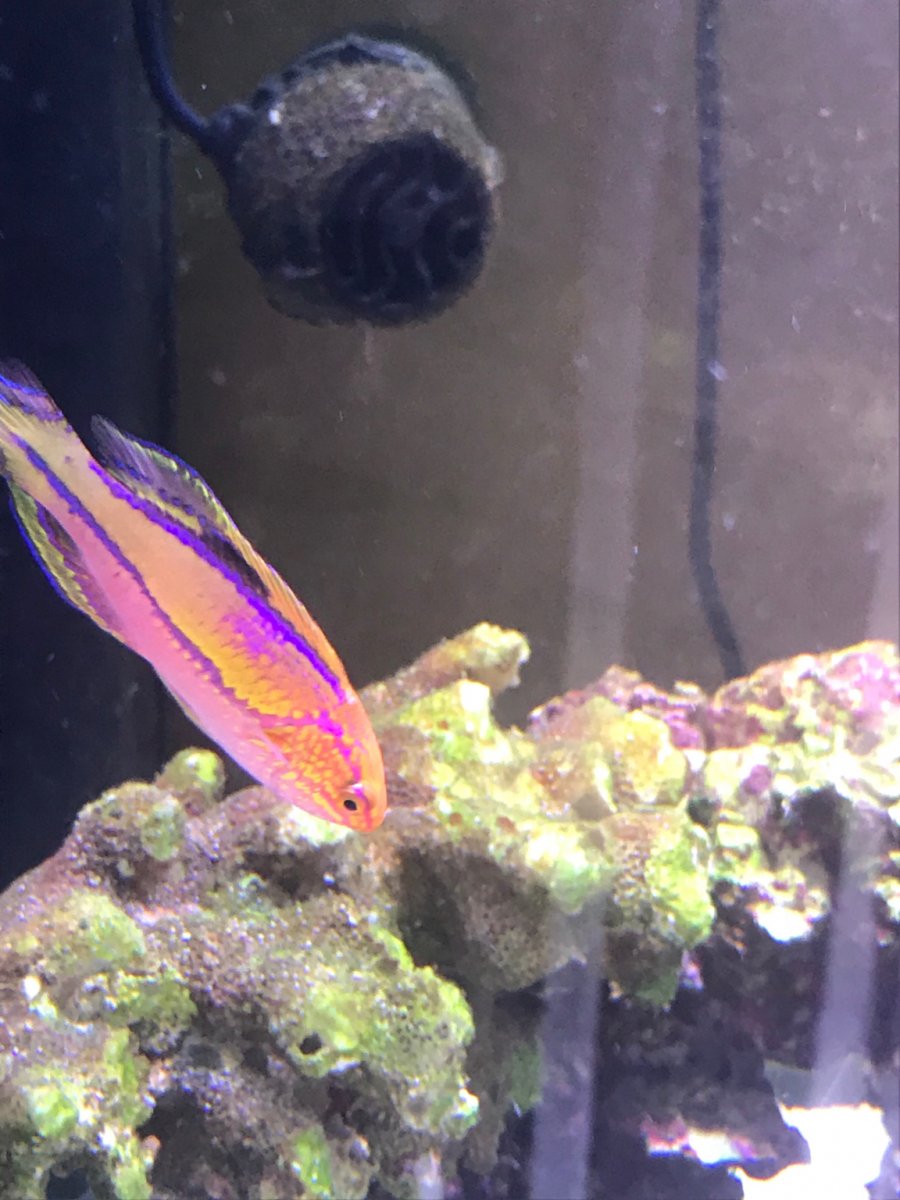
Male or female pintail wrasse?

Male
 
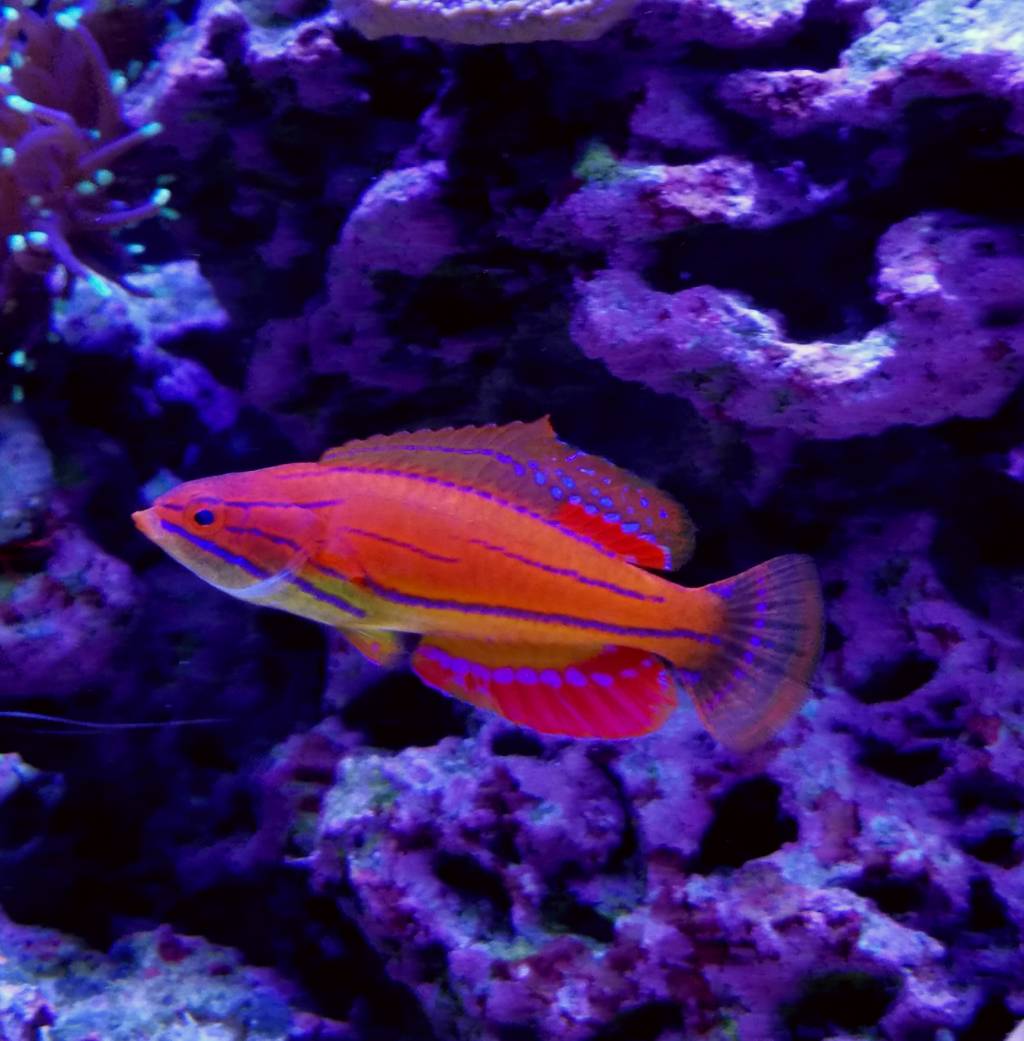
Wow, I wish the one I saw in my LFS is as bright red as this. I need this in my tank
When I got him his reds and even his orange was much less intense. Being in with other wrasses (and him being the dominant one) has really brought out some nice colors. I still don't think he's fully colored up yet.
 
So after the loss of my royal flasher (https://www.reef2reef.com/threads/flasher-wrasse-being-bullied-by-tankmates.356039/) I'm thinking about what to replace him with. The plan originally was to have two flashers of separate species if possible. Would this have worked in a 3ft/90cm tank (obviously using a social acclimation box for the second introduction)? If so are there any pairings that should be avoided? If two won't work in my tank I think I'll hold out for another royal, which seem to be quite uncommon here in the UK, as he was a stunning fish.
I would recommend adding a 3rd flasher. They will create a hierarchy, so having a 3rd breaks up the dominant attention from the boss of the hierarchy.

@eatbreakfast - It might be trivial to you but this is the first time am observing a transition of my Macropharyngodon Bipartitus transition from female to male . Its probably the last 2 days that his face color has completely changed and today his body is getting wayy darker than normal and slowly making transition.
I remember carefully only 2 changes made in the tank in the last 4 weeks :-

1. I used to feed 3 times a day with mysis , LRS and now started feeding 5 times a day including 1 extra meal of only dry TDO pellets .
2. Reduced the temparature of reef from 77.5 to 76 F

Both changes have shown positive results with not only my fishes like anthias and other wrasses but also my acros with increased nutrients in tank.
I wish I could take a pic to show you guys !!! Super excited and want to see how long it takes for the entire transition and will it stop in the middle .

Even my OG Purple monster encrusting didn't give me such amazing pleasure :D

Regards,
Abhishek

Macropharyngodon transition can be fickle. I've had one complete it's transition in 10 days, and another begin it's transition only to stall out and be partially male patterned for almost a year. Though I do think fully transitioning is more the norm.

To me, a species like this transitioning feels the best. They aren't nearly as easy to transition as Cirrhilabrus, Paracheilinus, or even Halichoeres, so when they do transition you know you're doing something right.

I keep my temp at 76. Have an auto feeder feed pellets 2x's a day and I feed another 2-4 times a day. Just last month I had a female Anampses chrysocephalus transition into a male. I got her over 2 yrs ago as a tiny 1.5" baby.
 
I would recommend adding a 3rd flasher. They will create a hierarchy, so having a 3rd breaks up the dominant attention from the boss of the hierarchy.


Macropharyngodon transition can be fickle. I've had one complete it's transition in 10 days, and another begin it's transition only to stall out and be partially male patterned for almost a year. Though I do think fully transitioning is more the norm.

To me, a species like this transitioning feels the best. They aren't nearly as easy to transition as Cirrhilabrus, Paracheilinus, or even Halichoeres, so when they do transition you know you're doing something right.

I keep my temp at 76. Have an auto feeder feed pellets 2x's a day and I feed another 2-4 times a day. Just last month I had a female Anampses chrysocephalus transition into a male. I got her over 2 yrs ago as a tiny 1.5" baby.

Anything I can do other than feeding and temperature to help the transition ? Now am a little worried about the possibility of a stalled transition .

I do have an Anampses Chrysocephalus which is like 2.5 inch female . If she turns make , it's a sight to behold !!!

Last question - once transition is complete , possible to get the male a couple of females ? I guess it's risky but thought of asking though .

Regards,
Abhishek
 
Anything I can do other than feeding and temperature to help the transition ? Now am a little worried about the possibility of a stalled transition .

I do have an Anampses Chrysocephalus which is like 2.5 inch female . If she turns make , it's a sight to behold !!!

Last question - once transition is complete , possible to get the male a couple of females ? I guess it's risky but thought of asking though .

Regards,
Abhishek

I would add a few small females now. That should help complete the transition.
 
Beautiful McCoskers! Did he lose the top filament while with you? Do they grow back?
Honestly, I've had him for months and he's never had one. Didn't have one when I got him either, so I don't really know why he's lacking one....

Very beautiful! Is it me or is his mouth injured a little?
Nah, his mouth is good. Just turns out that the best picture of him on the burst shot he happened to be stretching his jaw, too.
 
So I got my first Flasher Wrasse from Petco as McCosker's wrasse, which he isn't. Can anybody help ID him for me. I know that this is a stressed fish, and the color is not what I would call healthy settle fish, but maybe I am lucky and someone can correctly positively ID him for me. I am leaning toward Carpenter's wrasse but I am very new. I got a Fairy wrasse mislabeled as Tono's Fairy wrasse about 1 month ago and this one. They are not in the same tank right now but eventually will/may ended up in my 320 DT.
CarpenterFlasher2018021001.jpg
CarpenterFlasher2018021002.jpg
 
Paracheilinus flavianalis.
 
Body coloring doesn't matter too much with the commonly available flashers. Look at dorsal filament count, anal fin color and pattern, and caudal fin shape.
 
What's the chances of keeping a c. lunatus and a c. isosceles together in a 40 gallon if introduced at the same time?
 
What's the chances of keeping a c. lunatus and a c. isosceles together in a 40 gallon if introduced at the same time?
Not good in a 40g.
 

TOP 10 Trending Threads

Back
Top
Home
Post thread…
Market
What's new