

Bolus dosing

Lasse

10K Club member
View Badges

Joined
Mar 20, 2016
Messages
12,662
Reaction score
31,353
Location
Källarliden 14 D Bohus, Sweden
Rating - 0%
0   0   0
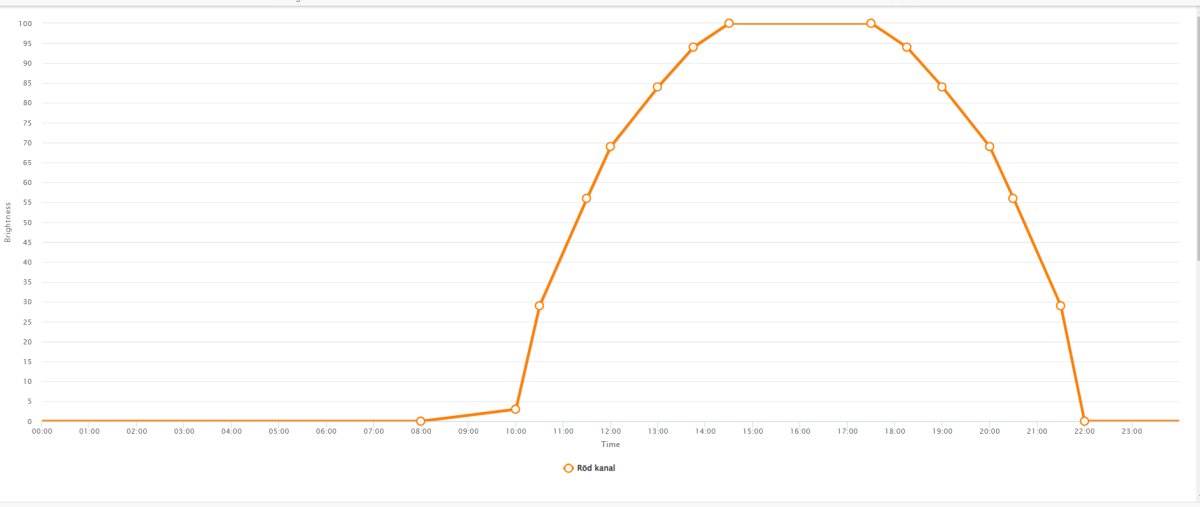
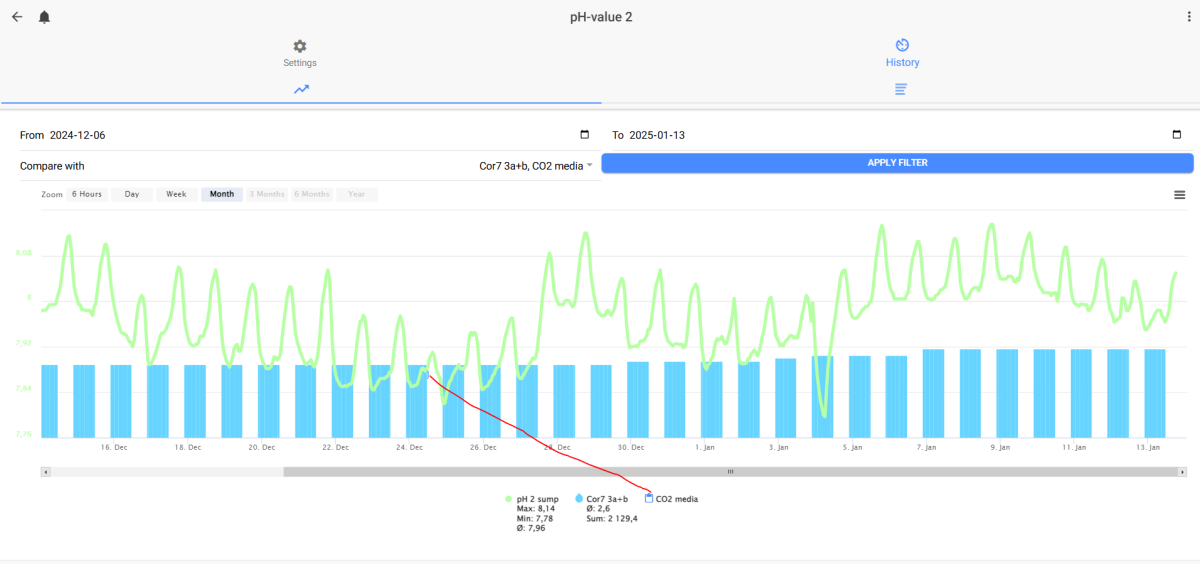
During the last months have my alkalinity dosing regime been to dose between 21:45 and 11:15 - during night with other words. This means that my alkalinity swing between 8.6 dKH in the morning and 7.6 dKH in the evening but my pH swing is only around 0.15. My light has been like the figure below.
1736788569954.png


My alkalinity demand has rise a little but not much - last months pH, dose and switch of CO2 media. I have rise the dose in three steps in order to withhold the alkalinity
1736790057074.png


Next step will be to introduce a light boost between 10:00 and 14:00 - go down to 65 % between 14:00 and 20:15 and after that follow my normal graph

I use Na₂CO₃ as alkalinity booster

Sincerely Lasse
 

Beruka

Community Member
View Badges
Joined
Dec 5, 2024
Messages
39
Reaction score
15
Location
Charlotte
Rating - 0%
0   0   0
Reefbum is a Fauna accredited advisor for their products.....not sure what that all encompasses. I know for sure it's for the trace elements beyond that I don't know.

I've known Keith for a long time.......kinda disappointed in him for going in this recent direction with his podcasts.

I believe he's been using a calcium reactor and kalk.
Ill give him a pass to be objective, but really what is old is new again with a few twists. I grew his frags like gangbusters and have no complaints. Not sure what is to be proven with single dosing and boosted early AM lights. Sounds like guruism instead just being stable and patient.

I could rant about direction and product line change up from BRS too but pointless.

Kalk is one of few additive that is cheap and works great. It doing 10-20% weekly water changes, I just have no concerns really with my tank fulling up to point it is chocking itself out.

I would go back to live rock, halides and ESV before doing Bolus. They are a version of baling. I wont be importing Eu bicarbonate. I am certain of that.
 
Last edited:

BeanAnimal

7500 Club Member
View Badges
Joined
Jul 16, 2009
Messages
9,293
Reaction score
15,594
Rating - 0%
0   0   0
Would FM agree? They spend much time explaining why bicarbonate is special.
They have special bicarbonate with special extras sprinkled in though, Randy. And those special things are not carbonate, per Claude’s own words. In his YT responses to the my questions about their calculator accuracy inaccuracy and concentration impossibility if it is bicarbonate, he directly stated so.

 
Last edited:

Welsh Reefer.

Community Member
View Badges
Joined
May 31, 2024
Messages
71
Reaction score
51
Location
Wales
Rating - 0%
0   0   0
Question - is it possible that warming the RO to an (unknown) temperature say 50*c when mixing to help fully dissolve the powder can convert some bicarb into carbonate?

I've done this a few times when needing to make a batch fast. Usually do it cold and shake canister multiple times over a day to get it dissolved without any settlement. But cold or warm mixing, I never see a pH drop upon dosing like I did with normal bicarb.
 

Randy Holmes-Farley

Reef Chemist
View Badges
Joined
Sep 5, 2014
Messages
89,263
Reaction score
92,316
Location
Massachusetts, United States
Rating - 0%
0   0   0
Question - is it possible that warming the RO to an (unknown) temperature say 50*c when mixing to help fully dissolve the powder can convert some bicarb into carbonate?

I've done this a few times when needing to make a batch fast. Usually do it cold and shake canister multiple times over a day to get it dissolved without any settlement. But cold or warm mixing, I never see a pH drop upon dosing like I did with normal bicarb.

Warm water may drive off CO2, yes. Not sure how much or how fast. Boiling definitely would and is an alternate way to make a carbonate solution from baking soda.
 

Pod_01

Valuable Member
View Badges
Joined
Jan 10, 2022
Messages
1,753
Reaction score
1,552
Location
Waterloo
Rating - 0%
0   0   0
Warm water may drive off CO2, yes. Not sure how much or how fast. Boiling definitely would and is an alternate way to make a carbonate solution from baking soda.
Really, when I used FM Balling light I always boiled water.
Well that is interesting… learn something new every day…
 

rtparty

7500 Club Member
View Badges
Joined
Jan 19, 2010
Messages
8,667
Reaction score
14,885
Location
Utah
Rating - 100%
4   0   0
Yes. Although there's variables at play of course, I've since increased coral load a bit from the time dosing hydroxide and changed skimmer to a larger one. Sodium hydroxide based two part dosed to maintain alk level over 24hrs (Reef Zlements PH+), I found an old graph:
1000046757.jpg


Fauna Marin balling light dosed hourly to maintain alk
1000046758.jpg


Fauna Marin Bolus dosing
1000046759.jpg


All graphs captured in cold winter/autumn time so house co2 variables will be very similar.

Larger skimmer bringing in more air can explain this pH bump all by itself. Especially if the first skimmer may have been undersized.

Then throw in a completely different pH monitor/tool/probe and voila “magic”

I ran my old 250 on the Hydros system and it showed my pH in a certain range. I don’t recall that range. Something like 8.2 to 8.4. Calibrated probe and all. I switched out to Apex and now my pH showed something like 7.9 to 8.2. Again, calibrated probe and all. I had sold the Hydros system so I couldn’t try the Hydros probe on the Apex.

I never knew which one was accurate. Even after being calibrated they didn’t agree. This was my own personal foray into pH probes/systems being wildly inaccurate/different.

No claims can be made in any way when so many variables are introduced.
 

Garf

5000 Club Member
View Badges
Joined
Oct 23, 2020
Messages
6,776
Reaction score
7,578
Location
BEEFINGHAM
Rating - 0%
0   0   0
Really, when I used FM Balling light I always boiled water.
Well that is interesting… learn something new every day…
When I looked at the solubility of bicarb, above 60C appeared to be something to be avoided (from memory). If you had no precipitate after the solution cooled to room temperature then it appears logical the heat has increased the solubility, ie converted at least a portion to carbonate. 100 grammes of bicarb will not stay fully in solution at 15 - 20 degrees C, in 1 litre of water, for example. The old mixing instructions mentioned using "Luke warm" water, whatever that means in reality. Looking on the bright side, looks like you are not the only one.
 

Randy Holmes-Farley

Reef Chemist
View Badges
Joined
Sep 5, 2014
Messages
89,263
Reaction score
92,316
Location
Massachusetts, United States
Rating - 0%
0   0   0
Following up the boiling comment, it’s not just the heat, but the generation of pure H2O gas as a bubble which equilibrates some CO2 into it, and carries it away. Akin to using low CO2 air in aeration to raise pH.
 

Pod_01

Valuable Member
View Badges
Joined
Jan 10, 2022
Messages
1,753
Reaction score
1,552
Location
Waterloo
Rating - 0%
0   0   0
When I looked at the solubility of bicarb, above 60C appeared to be something to be avoided (from memory). If you had no precipitate after the solution cooled to room temperature then it appears logical the heat has increased the solubility, ie converted at least a portion to carbonate. 100 grammes of bicarb will not stay fully in solution at 15 - 20 degrees C, in 1 litre of water, for example. The old mixing instructions mentioned using "Luke warm" water, whatever that means in reality. Looking on the bright side, looks like you are not the only one.
I knew from past attempts to mix it that it would not mix at room temperature.
I remembered doing experiments in school with supersaturated solution so I boiled the water and mixed it. Recrystallization didn’t happen so I figured all is good…

You know amateur chemists here or junior kindergarten level chemist. Sometimes I feel like alchemist, my wife always ask if I am sure nothing is going to blow up.

Also the provided 5L container is not 5L more like 5.5L and FM suggest to fill it so there is that as well.
 

BeanAnimal

7500 Club Member
View Badges
Joined
Jul 16, 2009
Messages
9,293
Reaction score
15,594
Rating - 0%
0   0   0
To be sure here - none of this changes the amount of Alk available (the concentration) assuming it is all dissolved either way, hot or cold, just the pH of the resulting stock solution that you are dosing from :)
 

Pod_01

Valuable Member
View Badges
Joined
Jan 10, 2022
Messages
1,753
Reaction score
1,552
Location
Waterloo
Rating - 0%
0   0   0
To be sure here - none of this changes the amount of Alk available (the concentration) assuming it is all dissolved either way, hot or cold, just the pH of the resulting stock solution that you are dosing from :)
That I figured out...
But, going from 5L to 5.5L (or so) will change the alk solution potency. Which in turn makes the FM numbers/ calculator wonky… Nothing like using questionable FM calculator and adding additional uncertainty.
 

idal305

Community Member
View Badges
Joined
Jan 14, 2025
Messages
29
Reaction score
24
Location
miami
Rating - 0%
0   0   0
So you are actually claiming that the pH of your aquarium is higher using sodium bicarbonate than when maintaining similar alk with carbonate or hydroxide?

I don’t recall even FM making a claim like that, although I may easily have just not seen it.
Reefbum - Doug Dorrat video @ 1hr 24 mins he goes into this and says he’s provided some proof on his personal channel.
 

BeanAnimal

7500 Club Member
View Badges
Joined
Jul 16, 2009
Messages
9,293
Reaction score
15,594
Rating - 0%
0   0   0
Reefbum - Doug Dorrat video @ 1hr 24 mins he goes into this and says he’s provided some proof on his personal channel.
IMHO Doug is wrong more than a broken clock and essentially just talks over the shelter of Claude's shoulder, repeating most of what Claude says, but like a game of telephone, adding his own spin.

The man's last "proof" after being shown to be incorrect was a silly video with a literal attempt at subliminal messaging.
 

Randy Holmes-Farley

Reef Chemist
View Badges
Joined
Sep 5, 2014
Messages
89,263
Reaction score
92,316
Location
Massachusetts, United States
Rating - 0%
0   0   0
Reefbum - Doug Dorrat video @ 1hr 24 mins he goes into this and says he’s provided some proof on his personal channel.

I don’t doubt he has convinced himself. I’m happy to discuss the evidence, if anyone knows what it might be, but I’m not going to search through his personal video channel for it.
 

MnFish1

10K Club member
View Badges
Joined
Dec 28, 2016
Messages
26,916
Reaction score
24,617
Location
Midwest
Rating - 100%
2   0   0
Dear all,

I saw a video about bolus dosing by Fauna Marin (in german). The idea there is to dose the whole dose of KH in the morning 30mins before lights on and then start the light directly at 120% to then decrease throughout the day. The idea is to get a pH boost right at the beginning of the day. FM says this is only possible with their balling light system since it contains bicarbonate which avoids precipitation compared to carbonates.
I was just wondering, why it would be superior to other systems as long as you have a high pH throughout the day?
Has anyone heard about this method or tried it already? They say there is no need for sodalime for the skimmer or kalkwasser anymore because it boosts the pH enough. Their mentioned target level is >8.2.

Kind regards,
Dominik
I don't see any disadvantage - except many people want to have these tasks automated. (i.e. who does it when you're not home, etc). I do not believe that there is anything 'sacred' about their balling method that would allow this as compared to other methods, and bicarbonate can cause precipitation as well.
 

BeanAnimal

7500 Club Member
View Badges
Joined
Jul 16, 2009
Messages
9,293
Reaction score
15,594
Rating - 0%
0   0   0
I don’t doubt he has convinced himself. I’m happy to discuss the evidence, if anyone knows what it might be, but I’m not going to search through his personal video channel for it.
In that area of the video he is discussing the magic crystals and that they don't form when "high pH" dosing is used. In-fact saying that the precipitation is causing immense biofilm production, thus preventing the magic crystals -- and therefore the "high pH" solution will not give you a pH increase but will provide the alkalinity :zany-face:

Or something to that effect... bacteria eating through precipitation through perseverance... But that takes 2-9 weeks specifically, but you may need to literally "change rock" if you have run "high calcium" for long time, as it becomes non fixable. The tank can get addicted to Kalk too... but bolus fixes this.

And yes - the "proof" mentioned is the subliminal video linked earlier in this thread.

Please do -- entertain yourself and watch.... all of you.
 
Last edited:

Randy Holmes-Farley

Reef Chemist
View Badges
Joined
Sep 5, 2014
Messages
89,263
Reaction score
92,316
Location
Massachusetts, United States
Rating - 0%
0   0   0
In that area of the video he is discussing the magic crystals and that they don't form when "high pH" dosing is used. In-fact saying that the precipitation is causing immense biofilm production, thus preventing the magic crystals -- and therefore the "high pH" solution will not give you a pH increase but will provide the alkalinity :zany-face:

There are, of course, lots of inconsistencies here.

If one is talking about dosing hydroxide (kalk or sodium hydroxide) Then it can certainly be the case that there is more abiotic precipitation of calcium carbonate than if dosing bicarbonate. I expect that is generally true.

But there’s zero plausible way that does not lead to higher pH if you are able to maintain similar alkalinity. In fact, every bit of “wasted” alk dosed that way serves to drive the pH up even more. You are effectively adding hydroxide and removing carbonate, an overall process that must raise pH.


OH- (added) + CO3- + Ca++ —> CaCO3 + OH-
 

spsick

Valuable Member
View Badges
Joined
Feb 17, 2018
Messages
2,260
Reaction score
2,732
Location
Mpls, MN
Rating - 100%
2   0   0
Larger skimmer bringing in more air can explain this pH bump all by itself. Especially if the first skimmer may have been undersized.

Then throw in a completely different pH monitor/tool/probe and voila “magic”

I ran my old 250 on the Hydros system and it showed my pH in a certain range. I don’t recall that range. Something like 8.2 to 8.4. Calibrated probe and all. I switched out to Apex and now my pH showed something like 7.9 to 8.2. Again, calibrated probe and all. I had sold the Hydros system so I couldn’t try the Hydros probe on the Apex.

I never knew which one was accurate. Even after being calibrated they didn’t agree. This was my own personal foray into pH probes/systems being wildly inaccurate/different.

No claims can be made in any way when so many variables are introduced.

I have experienced this as well across pH probe brands. Milwaukee displays .1-.2 higher than equivalent BrS double junction probe. So I use the Milwaukee and pat myself on the back for achieving higher pH
 

Randy Holmes-Farley

Reef Chemist
View Badges
Joined
Sep 5, 2014
Messages
89,263
Reaction score
92,316
Location
Massachusetts, United States
Rating - 0%
0   0   0
I have experienced this as well across pH probe brands. Milwaukee displays .1-.2 higher than equivalent BrS double junction probe. So I use the Milwaukee and pat myself on the back for achieving higher pH

Old pH calibration buffers (especially pH 10) can also cause false high readings as the buffer absorbs CO2, drops in pH, and throws the calibration off.
 

TOP 10 Trending Threads

WHAT AMOUNT OF LIVE ROCK AND SAND SHOULD BE PRIORITIZED FOR OPTIMAL BIODIVERSITY/FILTRATION?

  • 100% live rock + bagged sand

    Votes: 38 27.1%
  • 100% dry rock + 100% live sand

    Votes: 47 33.6%
  • 50/50 live/dry rock, 50/50 live/bagged sand

    Votes: 31 22.1%
  • 75% live rock, 25% live sand

    Votes: 14 10.0%
  • 25% live rock, 75% live sand

    Votes: 10 7.1%
Back
Top






