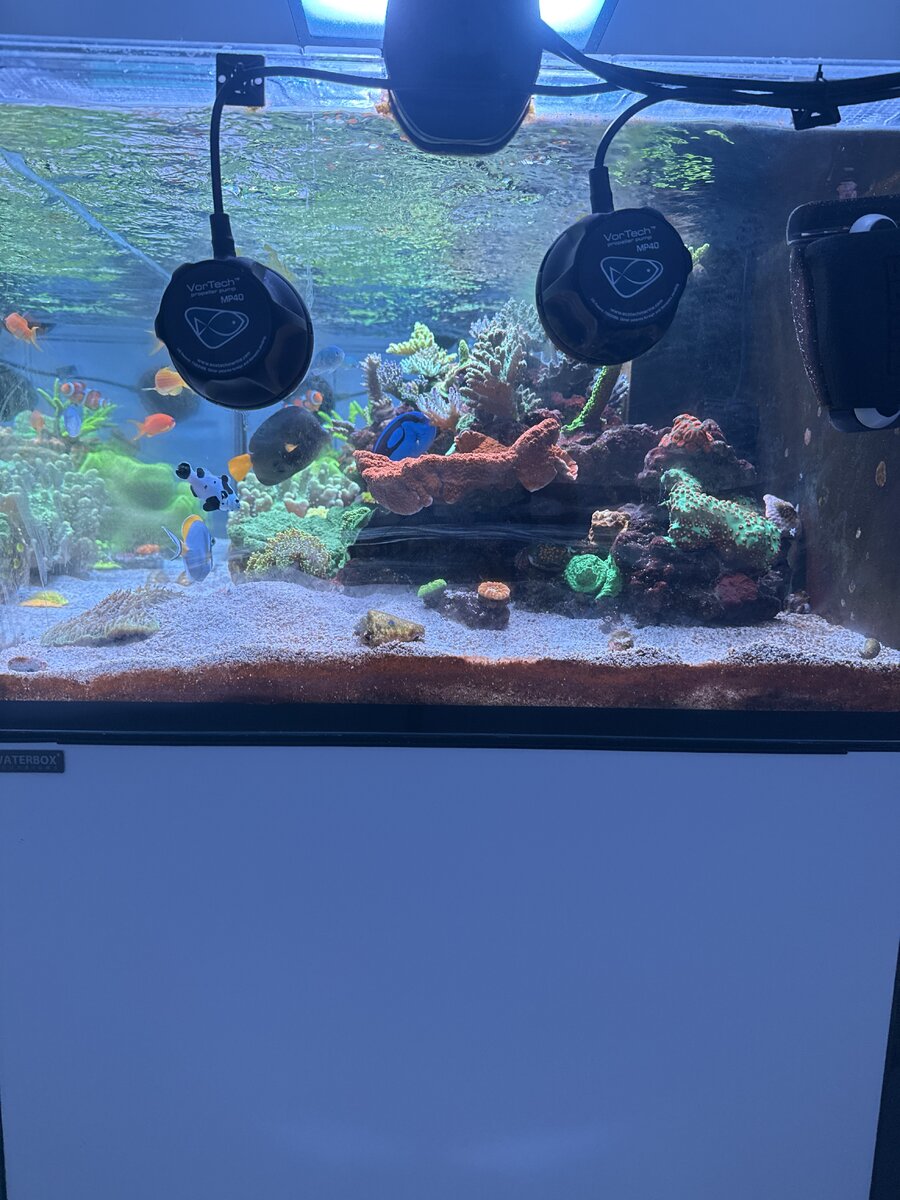
Brown/Red Algae in sand

jimmypencil

Active Member
View Badges
Joined
May 29, 2021
Messages
494
Reaction score
218
Location
south carolina
Rating - 100%
1   0   0
I have a red/brown algae that grows mainly on the glass beneath my sand line. I scrape it off when I clean the glass but it always comes back within a week. What is this? Never had this issue in any of my other tanks. This stuff mainly like I said grows on the glass beneath the sand line, not on top of the sand or on the glass.

This is a SPS dominated tank so par is really high around the tank probably 250+ even at the bottom and 500+ at the top of the rock work. I had Dino’s several months ago that took forever to go away. They were in the sand. Is this still Dino’s?

Nitrates 8
Phos .08
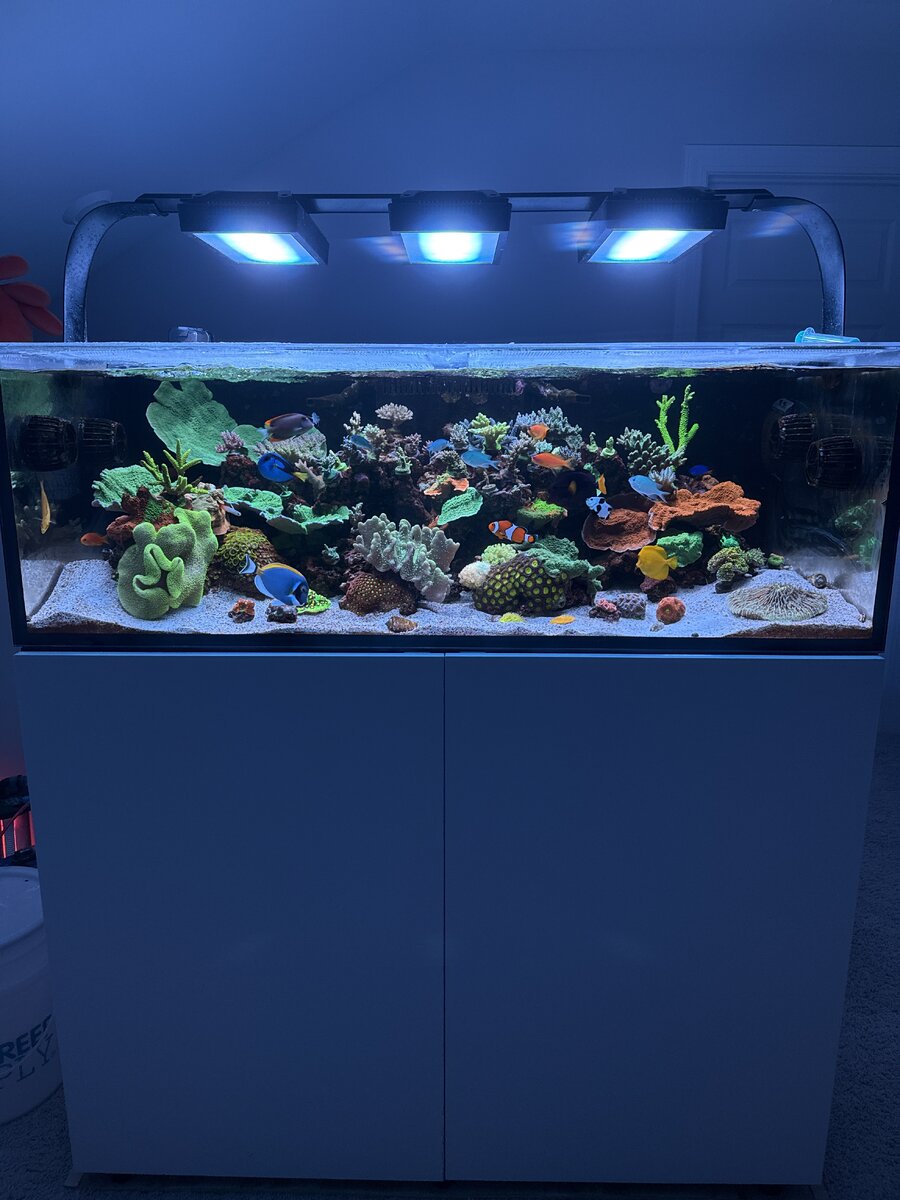
image.jpg
image.jpg
image.jpg
 
Kind of looks like dinos. There is a long thread on Dinos that explains how to tell if it's Dinos without using a microscope.
 
I think Cyanobacteria. I have the same red line in my 25 year mature high nutrient filter feeder lagoon.

PS: Incidentally, your tank is absolutely stunning.

Because you mentioned Dinoflagellets & I mentioned Cyanobacteria, which often rear their heads when inorganic nutrients, especially phosphorus & nitrogen, are limited, I have linked this paper:


“Colonies of the Caribbean coral Montastraea cavernosa exhibit a solar-stimulated orange-red fluorescence that is spectrally similar to a variety of fluorescent proteins expressed by corals. The source of this fluorescence is phycoerythrin in unicellular, nonheterocystis, symbiotic cyanobacteria within the host cells of the coral. The cyanobacteria coexist with the symbiotic dinoflagellates (zooxanthellae) of the coral and express the nitrogen-fixing enzyme nitrogenase. The presence of this prokaryotic symbiont in a nitrogen-limited zooxanthellate coral suggests that nitrogen fixation may be an important source of this limiting element for the symbiotic association.”
 
Last edited:
@jimmypencil I see you are using 4 vortech pumps. How long is your tank? Your corals are so happy and stunning. What program are you using for them? Or did you make your own? I have the same pumps. But only using 2. I am considering adding my two spares after seeing your tank.

Shelley
 
@jimmypencil I see you are using 4 vortech pumps. How long is your tank? Your corals are so happy and stunning. What program are you using for them? Or did you make your own? I have the same pumps. But only using 2. I am considering adding my two spares after seeing your tank.

Shelley
Thank you! It is a 4ft tank (waterbox infinia frag 125). I have the 4 wave makers on random mode at 55% intensity. I have two of them on the right side synced and the 2 on the left side are anti-synced. I’m happy with the flow!
 
As others have said, your tank is beautiful! I'd go easy as you fight it (but understand that it has been months).

My tank is very similar to yours with bright light, high flow, acros and low but measurable nutrients, and I too have been battling nuisance algae that seem rooted in the sand bed. I did try chemiclean and it knocked out the cyano with no issues to anything else. I've seen a resurgence of diatoms and film algae which is unsurprising as now there's one less competitor. Sand is now brown instead of red 🤷. But I will at least say my fish and cleanup crew actually eat the new stuff so hopefully it'll work itself out to a new balance eventually.

But ymmv so don't just dose based on my one experience! Good luck!
 
apologies, i forgot that @Subsea gave a very helpful reply. Do you suggest that i dose chemi clean to get rid of the cyano? Or just raise nutrients?
Chemi Clean works well when use as directed. Considering your previous Dinoflagellets infestation, I would raise nitrates as well.
 
Last edited:
As mentioned, Chemiclean can be useful in a situation like this.
As @Subsea also previewed, raising nutrients will help as well.
Another thing, I would siphon those sections of sand quite well, mix the sand up and then use Chemiclean. Stir the sand in those areas a little while using to expose as much of the cyano as possible.
Good luck and keep us posted.
I will end this with your tank is stunning!!
 
I have a red/brown algae that grows mainly on the glass beneath my sand line. I scrape it off when I clean the glass but it always comes back within a week. What is this? Never had this issue in any of my other tanks. This stuff mainly like I said grows on the glass beneath the sand line, not on top of the sand or on the glass.

This is a SPS dominated tank so par is really high around the tank probably 250+ even at the bottom and 500+ at the top of the rock work. I had Dino’s several months ago that took forever to go away. They were in the sand. Is this still Dino’s?

Nitrates 8
Phos .08
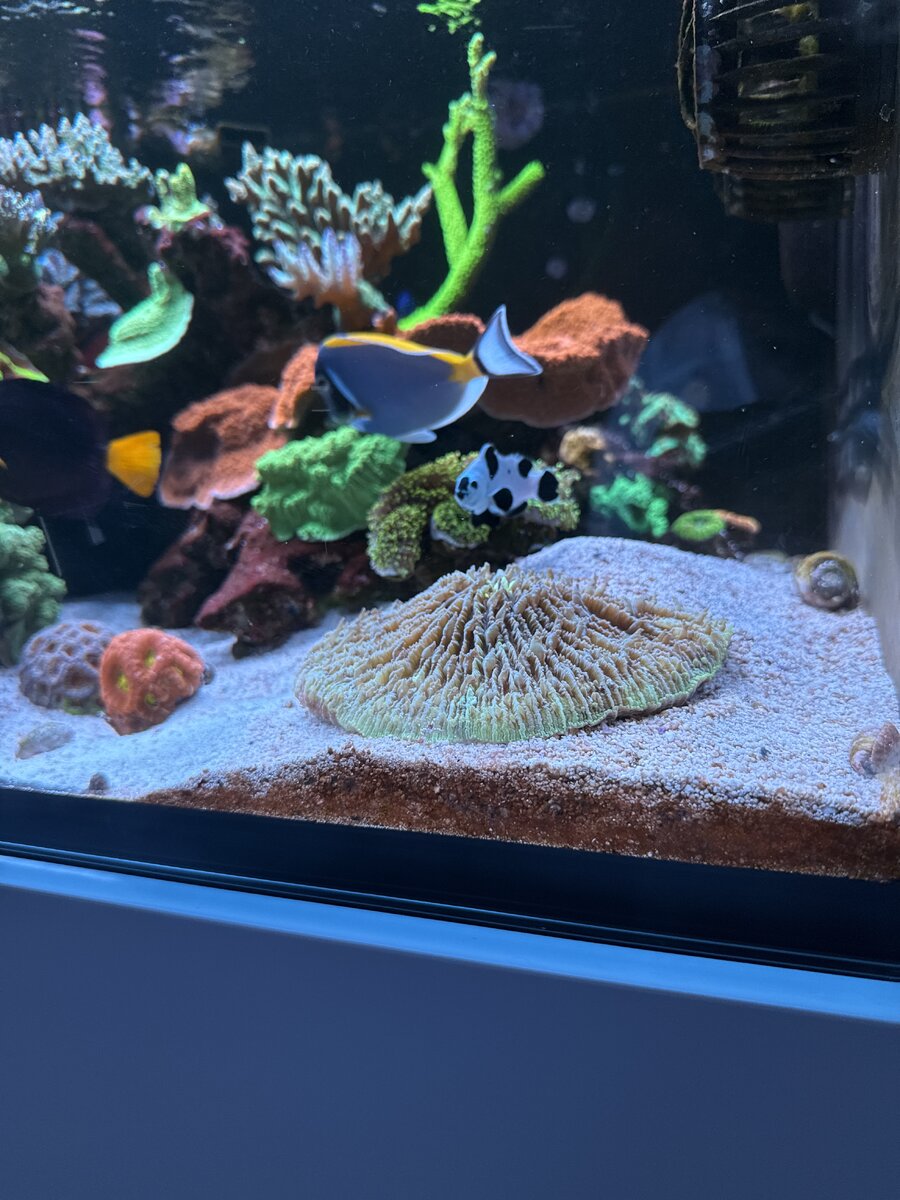
image.jpg
image.jpg
image.jpg
“This is a SPS dominated tank so par is really high around the tank probably 250+ even at the bottom and 500+ at the top of the rock work. I had Dino’s several months ago that took forever to go away. They were in the sand. Is this still Dino’s?“

Jimmy,
How did you eradicate your Dinoflagellet infestation?
 
“This is a SPS dominated tank so par is really high around the tank probably 250+ even at the bottom and 500+ at the top of the rock work. I had Dino’s several months ago that took forever to go away. They were in the sand. Is this still Dino’s?“

Jimmy,
How did you eradicate your Dinoflagellet infestation?
4-8 jars of galaxy pods a month, dosing phyto, dosing silicates, adding prodibio bacteria, Raising nutrients, manual removal daily, doing black outs, replaced my UV bulb that i think had gone bad. Not sure what fixed it because each method individually didnt have much effect. I could never figure out what strain it was under a microscope heres a picture. I think Amphidinium (Large-Cell)?


1783516082581.png
 
As mentioned, Chemiclean can be useful in a situation like this.
As @Subsea also previewed, raising nutrients will help as well.
Another thing, I would siphon those sections of sand quite well, mix the sand up and then use Chemiclean. Stir the sand in those areas a little while using to expose as much of the cyano as possible.
Good luck and keep us posted.
I will end this with your tank is stunning!!
Thanks for the info, will do. Should i be hesitant to use chemiclean if i just added several acros?
 
Thanks for the info, will do. Should i be hesitant to use chemiclean if i just added several acros?
Jimmy,
As I see it, you have an insignificant Cyanobacteria problem. Only you can make the decision as to the necessity for the use of Chemiclean.


From my perspective, I consider Cyanobacteria part of the marine ecosystem. Certain Cyanobacteria species, living in coral biomass, provide a source of nitrogen when inorganic nitrogen in water is limited.


Corals host special bacteria called cyanobacteria to survive in nutrient-poor waters. These cyanobacteria are diazotrophs, meaning they "fix" nitrogen. They pull inert nitrogen gas from the water and convert it into ammonia (a usable nutrient). This process fuels the coral and its symbiotic algae (zooxanthellae). [1, 2, 3, 4, 5]
 
Last edited:
@Subsea has it correct, the cyano is minimal and beneficial when not in plague proportions, which you do not have.
I’d keep siphoning and stirring that sand. It will go away on its own.
 
I could never figure out what strain it was under a microscope heres a picture. I think Amphidinium (Large-Cell)?
The image you shared is Ostreopsis. You can see how many of those cells have a "pointy" end. They move like they are fixing some point in the distance and then circle around it.
1783523820122.png

Prorocentrum has often a flat or concave end while remaining quite symmetrical and the "central pyrenoid" (round thing in the center).
2025-11-30 17-18-35 (A,R2,S1).jpg

Amphidinium (small and large cell) most often have a "beak" or "nose" making them asymmetrical:
Amphidinium_Small.jpg
 
Jimmy,
As I see it, you have an insignificant Cyanobacteria problem. Only you can make the decision as to the necessity for the use of Chemiclean.


From my perspective, I consider Cyanobacteria part of the marine ecosystem. Certain Cyanobacteria species, living in coral biomass, provide a source of nitrogen when inorganic nitrogen in water is limited.


Corals host special bacteria called cyanobacteria to survive in nutrient-poor waters. These cyanobacteria are diazotrophs, meaning they "fix" nitrogen. They pull inert nitrogen gas from the water and convert it into ammonia (a usable nutrient). This process fuels the coral and its symbiotic algae (zooxanthellae). [1, 2, 3, 4, 5]
Details are important. Coral zooxanthellae are a specific type of Dinoflagellets.

As identified by @EnterName, the Dinoflagellets that you have are Ostreopsis, which are mobile and treatable with UV sterilization, if you feel that is beneficial in your ecosystem.

In my ecosystems, I promote multiple nutrient pathways to provide sustainable live food for diverse filter feeders & suspension feeders AND UV STERILIZER is not desirable.

However, in 55G seaweed growout tank, UV sanitation was desirable as phytoplankton bloom competed with desirable macroalgae cultivation.

Different strokes for different folks.

image.jpg
 
Last edited:
The image you shared is Ostreopsis. You can see how many of those cells have a "pointy" end. They move like they are fixing some point in the distance and then circle around it.
1783523820122.png

Prorocentrum has often a flat or concave end while remaining quite symmetrical and the "central pyrenoid" (round thing in the center).
2025-11-30 17-18-35 (A,R2,S1).jpg

Amphidinium (small and large cell) most often have a "beak" or "nose" making them asymmetrical:
Amphidinium_Small.jpg
Thank you very much for the ID help!

I decided to bring out the microscope again to look at my current red/brown algae issue. I took a sample of the algae on the glass and I took a sample from the sand that has the same red brown stuff on it. Does any of this look like Dino’s to you? I can get better/different pictures if needed.

These were the sand sample

IMG_9608.png
IMG_9610.png
IMG_9609.png


These were the glass sample
IMG_9606.png

IMG_9611.png

IMG_9607.png
 
@jimmypencil

From a first glance I would say something like Coolia sp., but there are thousands of species that sometimes can very much look alike. You are welcome to share the best image you can get on my microscopy thread if you like 😊.
 
Last edited:

ARE YOU READY TO CONFESS TO CRAZIEST, DUMBEST, FUNNIEST THING YOU’VE EVER DONE IN REEFING?

  • Yeah, I'll confess! (Share your story in the comments!)

    Votes: 26 63.4%
  • Nah, I'll keep mine a secret...(Don't be like that, share with the class!)

    Votes: 15 36.6%
Back
Top
Home
Post thread…
Market
What's new