


Do deep sand beds really help remove nitrates?

Windy

Active Member
View Badges
Joined
Jun 1, 2014
Messages
483
Reaction score
86
Location
Oregon
Rating - 0%
0   0   0
The ability to attain natural nitrate reduction via degasing (via live rock, dsb) is so inconsistently harnessed, they had to invent biopellets

the dsb/low nitrate approach was ran through 2 mil reefs 1998-curr

then came biopellets to make repeatable good

its not that its unattainable, I believe huge amounts of live rock to very low fish bioloading can pull it off, but so few people set up tanks in that ratio while using a dsb that you can expect any depth to cause nitrates and not lower them. When the results change off 25 yrs documentation, biopellets w go away and berlin systems w be all the rage again


I have a dsb that reduces nitrates btw so don't flame me too bad :) for calling nay on them by and large

a golden ratio: no fish, 5 pounds per gallon porous coralline lr, kept organically unplugged via violent water changes, correct grain size, 6 inches, 9 yrs, and visual gas production w benthic life interspersed

I found in long term studies that even truly reductive dsb's using tiny reef models will become nutrient sinks if you don't blast clean them. critters in the sandbed contribute to waste sinking, not lower it, nothing eats detritus in a sandbed but a monsoon storm w full beach ejection occasionally sure does.
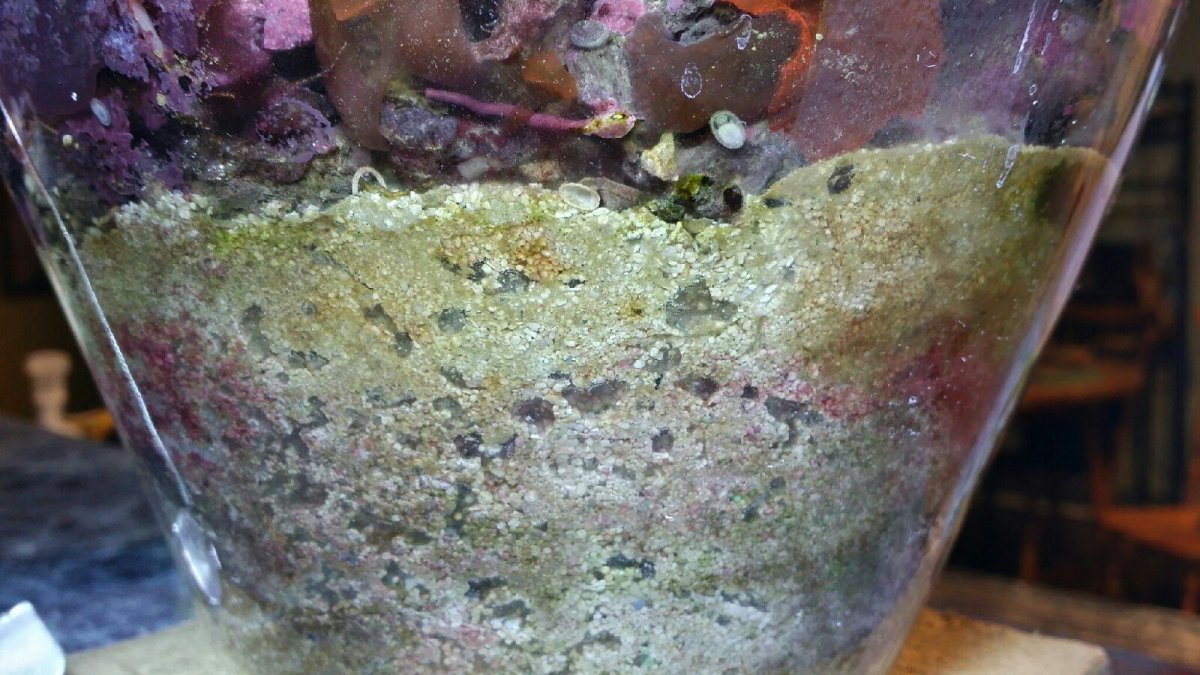
dsb.jpg

What studies? Where can we see the results or is this "climate" scince?

 

Zoaddicted

Active Member
View Badges
Joined
May 5, 2015
Messages
134
Reaction score
70
Location
San Mateo, CA
Rating - 0%
0   0   0
Its about as affective as having a ball of chaeto in your sump.

Sooo not really no.

Relying on anaerobic bacteria to break down nitrates is just silly. It works but probably not enough. You need a significant amount of anaerobic bacteria to really make it worth while.

How much DSB space vs your bioload accumulation rate?

Imagine having a 50 gallon refugium on a 40 gallon display tank VS having a 5 gallon refugium on a 40 gallon tank.

Do your water changes. Or set up a biopellet reactor.
 

ReefMadScientist

Valuable Member
View Badges
Joined
Mar 3, 2014
Messages
2,130
Reaction score
1,049
Location
Gilbert, AZ
Rating - 0%
0   0   0
Its about as affective as having a ball of chaeto in your sump.

Sooo not really no.

Relying on anaerobic bacteria to break down nitrates is just silly.

Do your water changes. Or set up a biopellet reactor.

And to add on. Use less fish in your tank and feed better proportions. You will not have any NO3 issues.
 

Randy Holmes-Farley

Reef Chemist
View Badges
Joined
Sep 5, 2014
Messages
89,282
Reaction score
92,334
Location
Massachusetts, United States
Rating - 0%
0   0   0
Relying on anaerobic bacteria to break down nitrates is just silly. It works but probably not enough. You need a significant amount of anaerobic bacteria to really make it worth while.
.

FWIW, organic carbon dosing and biopellets also use anaerobic bacteria. The difference is that sand beds rely on organics naturally present in the aquarium while organic carbon dosing adds some more. ;)
 

brandon429

what, exactly, are you doing in your avatar
View Badges
Joined
Dec 9, 2014
Messages
31,035
Reaction score
23,923
Location
tejas
Rating - 0%
0   0   0
Windy Im curious as to why biopellets and the rest of the lot came into play, and berlin went out, if the studies that show sand based nnr turned out to be accurate for the masses in hindsight?

Ive no doubt that NNR occurs in every reef tank here, significance to me was the ranging factor unaccounted for, that biopellets carbon boosting and plants take the role of handling nowadays. Berlin system would be holding strong as a low nitrate approach if those older studies applied to the variability in reefs we see today. Like a few other things in reefing, algae control specifically, the broad stroke offered didn't cut it
 

Randy Holmes-Farley

Reef Chemist
View Badges
Joined
Sep 5, 2014
Messages
89,282
Reaction score
92,334
Location
Massachusetts, United States
Rating - 0%
0   0   0
Windy Im curious as to why biopellets and the rest of the lot came into play, and berlin went out, if the studies that show sand based nnr turned out to be accurate for the masses in hindsight?

Ive no doubt that NNR occurs in every reef tank here, significance to me was the ranging factor unaccounted for, that biopellets carbon boosting and plants take the role of handling nowadays. Berlin system would be holding strong as a low nitrate approach if those older studies applied to the variability in reefs we see today. Like a few other things in reefing, algae control specifically, the broad stroke offered didn't cut it

My opinion is:

1. Not effective enough for many people (like me).
2. Does nothing for phosphate.
3. Takes up a lot of space.
4. Some worry about, or even experience, hydrogen sulfide
 

naecO rM

Active Member
View Badges
Joined
Nov 26, 2014
Messages
126
Reaction score
41
Rating - 0%
0   0   0
My opinion is:

1. Not effective enough for many people (like me).
2. Does nothing for phosphate.
3. Takes up a lot of space.
4. Some worry about, or even experience, hydrogen sulfide

Hi Randy,
What you could recomnend for nitrates and phosphates export?
 

Randy Holmes-Farley

Reef Chemist
View Badges
Joined
Sep 5, 2014
Messages
89,282
Reaction score
92,334
Location
Massachusetts, United States
Rating - 0%
0   0   0
Hi Randy,
What you could recomnend for nitrates and phosphates export?

Many methods work very well. I use skimming, organic carbon dosing, GFO, large rock filled reufgia, water changes (1% daily, automatically), and GAC (not a big effect from it), and growing macroalgae on my system. :)
 

CastAway

Prone to wander, never lost.
View Badges
Joined
Jun 9, 2013
Messages
4,457
Reaction score
3,108
Location
Knoxville TN
Rating - 0%
0   0   0
I had not thought about effectiveness as it relates to physical space. Has me wondering now, as I think the same volume of large rubble might result in a larger pod population.
 

naecO rM

Active Member
View Badges
Joined
Nov 26, 2014
Messages
126
Reaction score
41
Rating - 0%
0   0   0
Many methods work very well. I use skimming, organic carbon dosing, GFO, large rock filled reufgia, water changes (1% daily, automatically), and GAC (not a big effect from it), and growing macroalgae on my system. :)
Thank you Randy!
I do skimming, Macroalgae Chaeto, Caulerpa, My self DIY GFO Reactor.
No carbon, no water changes 18 months, no sandbad.
Classic Balling method. Bacteria dosing weekly.
Here is my tank.
a1e28eef936e10d302bd1a3139a93f1b.jpg

Next month's I have to put sps frags to the Reef.
Can I asked you what do you thing about my tank? Can I continue the same method or I have to go to the water changes?
Thank you.
 

s2nhle

Valuable Member
View Badges
Joined
Mar 12, 2013
Messages
1,413
Reaction score
323
Location
VA
Rating - 0%
0   0   0
Waste piled up which released the bad stuffs back to the water.
 

Oceansize

Active Member
View Badges
Joined
Jun 1, 2015
Messages
485
Reaction score
230
Location
Costa Mesa, CA
Rating - 0%
0   0   0
Relying on anaerobic bacteria to break down nitrates is just silly. It works but probably not enough. You need a significant amount of anaerobic bacteria to really make it worth while.

Do your water changes. Or set up a biopellet reactor.

Or set up a sulphur denitrator. That's how you get "a significant amount of anaerobic bacteria to really make it worth while." Less than 2 gallons of water in a reaction chamber with sulphur pellets can denitrate up to 250 gallons of display water. Replenish the sulphur every year or so. Easy peasey. :)
 

klp

Active Member
View Badges
Joined
Mar 10, 2015
Messages
438
Reaction score
299
Location
Phoenix, Arizona
Rating - 0%
0   0   0
to me that sounds like each tank with a dsb though, they tried for decades to get NNR on any possible consistent basis using *typical tank arrangements, namely just dsb's, and it was such a long shot biopellets came about instead since the other really doesn't work with todays typical reef tanks

plant binding always was consistent but not true in-tank NNR without very special planning, the kind of planning we don't see across forum tanks. Randy keeps a trash can full of lr, that's an unusual and likely functional ratio

there are 5 gallon bucket remote dsbs, reverse dsbs im sure with changing degrees of working

but theres biopellets to amend all the variability~
Could you define NNR. I believe it is Nitrate Nirtogen Reduction but I am not sure. Thanks.
 

Wiz

2500 Club Member
View Badges
Joined
Dec 1, 2014
Messages
4,317
Reaction score
2,639
Location
Allenstown nh
Rating - 0%
0   0   0
I was reading through this thread and just wanted to set an example. My 40b reef is PACKED. every kind of coral you can imagine. 12 fish. 2 shrimp. 2 12"+ serpent stars and a 6" brittle. 4 btas. Lots of snails and hermits. 2 mithrax. Etc.... I run a 30l 7" oolitic dsb/macro fuge, a 20g sump with skimmer and carbon only. No water changes and heavy feeding. 2-3 times per day of a variety of frozen, flake, pellet, nori, and live foods (brine and blackworms). 2 scoops od reef chilli every other night. If any tank was going to have a nitrate/phos issue it would be mine. My fuge is the best investment I've put into my system. Nitrate and phos are unmeasurable and pod population is enough to sustain my pair of manderin, a six line, two watchman gobies, and a springeri dottyback which are all bug eaters. I know there is a lot of speculation about dsb and variables that could affect your experience. But it is my opinion that my dsb fuge is one of if not the most important part of my system. And I don't believe I would be keeping this many organisms healthy with that amount of feeding and no water changes without it. Just my experience.

rps20160205_171541.jpg


rps20160126_161605.jpg
 

Wiz

2500 Club Member
View Badges
Joined
Dec 1, 2014
Messages
4,317
Reaction score
2,639
Location
Allenstown nh
Rating - 0%
0   0   0
Also, I believe dsbs only become toxic when they are not healthy. As you can see in the lower right of my fuge pic I had to disturb my dsb to plant a mangrove. The black splotchs are dead organisms in the sand that are forming toxic gas.(not to be confused with the algae growing against the glass) But in a healthy fuge the macrofauna will clean this area and return it to health. In this pic you can clearly see that the two smaller splotchs are almost gone and the large one is very much lighter. I am quite content with the cleaning ability of my healthy dsb.

20160215_092409.jpg
 

KWSanders

Community Member
View Badges
Joined
Jan 14, 2012
Messages
32
Reaction score
44
Location
Yorktown
Rating - 0%
0   0   0
so you have one reefer with a DSB. to reduce nitrates and another dosing with stump remover. KNO 3. I'm confused
 

TOP 10 Trending Threads

WHAT AMOUNT OF LIVE ROCK AND SAND SHOULD BE PRIORITIZED FOR OPTIMAL BIODIVERSITY/FILTRATION?

  • 100% live rock + bagged sand

    Votes: 38 26.6%
  • 100% dry rock + 100% live sand

    Votes: 48 33.6%
  • 50/50 live/dry rock, 50/50 live/bagged sand

    Votes: 32 22.4%
  • 75% live rock, 25% live sand

    Votes: 15 10.5%
  • 25% live rock, 75% live sand

    Votes: 10 7.0%
Back
Top









