



Micro Scrubbing Bubbles.

Status
Not open for further replies.

Reefahholic

Acropora Farmer
View Badges
Joined
Sep 5, 2014
Messages
8,134
Reaction score
6,155
Location
Houston, TX
Rating - 0%
0   0   0
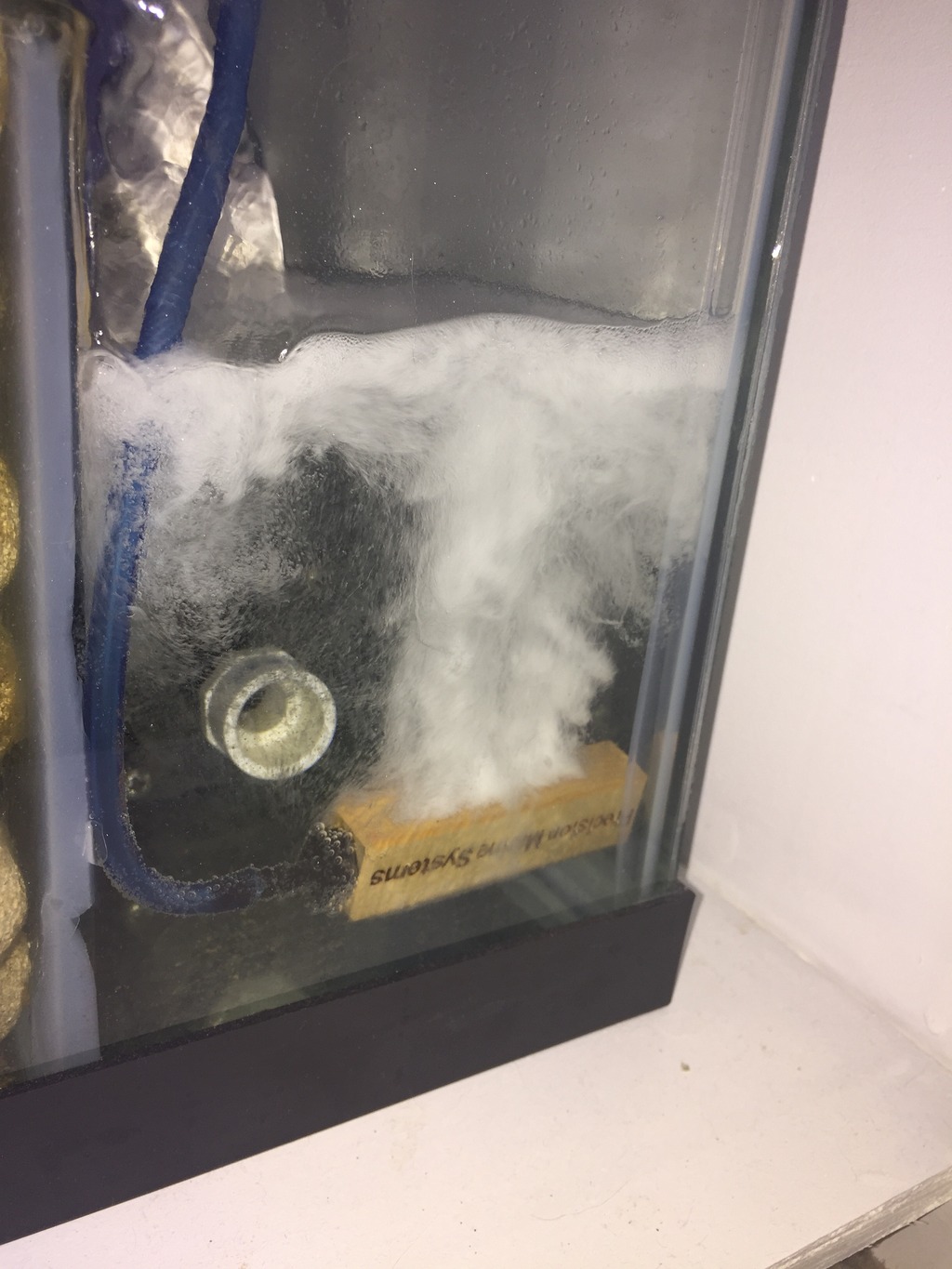
Well, I've tested multiple air stones. Tested the Venturi method at both High and Low pressures. Here's my short term observations.

All methods seem to work about the same until you add more stones or entrain more air. I'm personally liking less bubbles and only one small lime wood stone on the bottom away from the return pump. As far as what seems to work better, it's too early for me to comment on that. I will say that the corals and fish haven't been affected negatively either way. Corals appear to be responding the same to a small amount of bubbles or a large amount of bubbles. All the methods seem to produce the tiny micro bubbles that stay suspended in the water column for hours "with the flow on." With all flow off, they eventually make there way to the surface and pop. Of course...that's what bubbles do. The last question in my mind is what are the long-term affects of both a minimal amount of bubbles and a larger amount of bubbles floating in the water column. Minimal haze vs maximal haze I guess you could say. Will the maximal haze achieve better results that appear quicker or is it just a waste of time? The issue I've ran into with more haze or maximal bubble output is the amount popping on the surface. I believe this is due to my loc-line being at the surface. Both smaller and larger bubbles pop if the amount is increased or with more air entrainment. Another thought going through my mind is what if we had a return pump inside the tank like the one that EC was using on the sandbed with a 90 degree elbow forcing bubbles horizontally across the tank at that lower level? Would this allow for more output or haze with less bubbles making it to the surface? Would this technique speed up results and be more affective? I guess that's a project/ debate for another day.




The Macro Guy

Active Member
View Badges
Joined
Apr 17, 2015
Messages
117
Reaction score
182
Location
United States
Rating - 0%
0   0   0
Well, I've tested multiple air stones. Tested the Venturi method at both High and Low pressures. Here's my short term observations.

All methods seem to work about the same until you add more stones or entrain more air. I'm personally liking less bubbles and only one small lime wood stone on the bottom away from the return pump. As far as what seems to work better, it's too early for me to comment on that. I will say that the corals and fish haven't been affected negatively either way. Corals appear to be responding the same to a small amount of bubbles or a large amount of bubbles. All the methods seem to produce the tiny micro bubbles that stay suspended in the water column for hours "with the flow on." With all flow off, they eventually make there way to the surface and pop. Of course...that's what bubbles do. The last question in my mind is what are the long-term affects of both a minimal amount of bubbles and a larger amount of bubbles floating in the water column. Minimal haze vs maximal haze I guess you could say. Will the maximal haze achieve better results that appear quicker or is it just a waste of time? The issue I've ran into with more haze or maximal bubble output is the amount popping on the surface. I believe this is due to my loc-line being at the surface. Both smaller and larger bubbles pop if the amount is increased or with more air entrainment. Another thought going through my mind is what if we had a return pump inside the tank like the one that EC was using on the sandbed with a 90 degree elbow forcing bubbles horizontally across the tank at that lower level? Would this allow for more output or haze with less bubbles making it to the surface? Would this technique speed up results and be more affective? I guess that's a project/ debate for another day.












How does that device work for you? I want to make something similar, but having the airlines on top, and one open side, pretty much a funnel so that there is no bubble loss at the start.
 

Cruz_Arias

Well-Known Member
View Badges
Joined
Mar 30, 2016
Messages
789
Reaction score
432
Rating - 0%
0   0   0
Refraction does not twinkle unless something is changing with time. It is not time dependent. It is simply the bending of light at interfaces. It is steady unless the object is tumbling and not symmetrical (e.g., probably not a bubble), or is large relative to the beam size and so moves in and out of the beam (like scattering would). Aside from the angular dependence (which folks here are not discussing), I do not see how you are distinguishing scattering from refraction using a laser pointer.


FWIW, here's a detailed comment from the manufacturer of machines designed to measure particle sizes by light scattering:

http://www.shimadzu.com/an/powder/sald/data/appli/app10.html

"When reports come in of Micro-bubbles and nano-bubbles existing in a stable state for a long time, we are sometimes confronted with the question of whether they really are air bubbles or in fact particles (solids or liquids?).
Yet, it is extremely difficult to judge whether they are air bubbles or particles merely by taking a glance at them. Also, it is impossible to judge this by measuring bubble size distribution or particle size distribution and looking at these measurement results."

In summary, their machine can do it, but the difference is minor and relates to the relative amount of light scattering at different angles. It is not a simple DIY with a laser pointer.

:) fair enough! :)
Guess we need to find a different method if there are zero particulates in our water column... (which of course would be hugely detrimental to the domestic reef ecosystem)
 

Tautog

Valuable Member
View Badges
Joined
Jan 23, 2016
Messages
1,707
Reaction score
1,620
Rating - 0%
0   0   0
For what it's worth, I entered this thread 30 pages ago. My physics knowledge made me experiment with this whole bubble idea. When I added bubbles over nite, my water clarity didn't seem to change that much after 8 days, with daily feedings as the constant. No other changes were made. No water change, fish additions, nothing. I didn't worry about coral growth in such a short period of time, only looks. Again, I didn't see much difference. The next test was no bubbles. I aimed my 2 power heads at the surface. After one day, my water quality was incredible. My water was so clean it looked like there was no water in the tank. My corals seemed as happy as ever. Everything opened up overnight. I have to believe that the water quality, with greater surface movement, increased O2 level, made the difference. With the power heads operating at opposite ends of the tank, current collides in the middle and then pushes down to the rocks and sand bed. I still believe surface movement is key, not bubbles. Though the bubbles would drive debris to the top and back to the sump, O2 levels didn't increase, nor did water quality.
Furthermore, your skimmer is pulling protein out of the water, when protein is in the water. If your not feeding heavy, and there's a lack of proteins, your skimmer doesn't produce much waste.
Hey Randy, am I missing something? My experiment didn't have any variables other than bubbles vs surface movement. But each outcome was dramatically different, with surface movement being the winner in my opinion. Great thread.
 

Cruz_Arias

Well-Known Member
View Badges
Joined
Mar 30, 2016
Messages
789
Reaction score
432
Rating - 0%
0   0   0
For what it's worth, I entered this thread 30 pages ago. My physics knowledge made me experiment with this whole bubble idea. When I added bubbles over nite, my water clarity didn't seem to change that much after 8 days, with daily feedings as the constant. No other changes were made. No water change, fish additions, nothing. I didn't worry about coral growth in such a short period of time, only looks. Again, I didn't see much difference. The next test was no bubbles. I aimed my 2 power heads at the surface. After one day, my water quality was incredible. My water was so clean it looked like there was no water in the tank. My corals seemed as happy as ever. Everything opened up overnight. I have to believe that the water quality, with greater surface movement, increased O2 level, made the difference. With the power heads operating at opposite ends of the tank, current collides in the middle and then pushes down to the rocks and sand bed. I still believe surface movement is key, not bubbles. Though the bubbles would drive debris to the top and back to the sump, O2 levels didn't increase, nor did water quality.
Furthermore, your skimmer is pulling protein out of the water, when protein is in the water. If your not feeding heavy, and there's a lack of proteins, your skimmer doesn't produce much waste.
Hey Randy, am I missing something? My experiment didn't have any variables other than bubbles vs surface movement. But each outcome was dramatically different, with surface movement being the winner in my opinion. Great thread.


Where was your airpump? In the sump area? On the ground/floor near the tank?

How did you setup the airstone?
What type of air stone?
Were you getting a lot of bubbles popping in the display tank?
 

Cruz_Arias

Well-Known Member
View Badges
Joined
Mar 30, 2016
Messages
789
Reaction score
432
Rating - 0%
0   0   0

That was funny. A lot of supposition, no experience nor any understanding of any of the characteristics of micro-nanobubbles.

She couldn't find one nanobubble patent... lol 2 minute search on google?

No research papers on nanobubbles or microbubbles for dissolved air floatation in waste water treatment?

Correct, micro nanobubbles are not a miracle, it is a tool. Just like a skimmer.

It solves a problem or two.

Obviously it cannot cure idiocracy as demonstrated so well in this podcast.

LoL
 

Randy Holmes-Farley

Reef Chemist
View Badges
Joined
Sep 5, 2014
Messages
89,263
Reaction score
92,316
Location
Massachusetts, United States
Rating - 0%
0   0   0
Hey Randy, am I missing something? My experiment didn't have any variables other than bubbles vs surface movement. But each outcome was dramatically different, with surface movement being the winner in my opinion. Great thread.

IMO, these are the sorts of experiments that folks can do to figure out what benefits (if any) come from bubbles relative to other ways of accomplishing similar things. :)
 

NeptuneGarden

Active Member
View Badges
Joined
Mar 7, 2016
Messages
176
Reaction score
170
Location
Houston
Rating - 0%
0   0   0
I don't doubt people's success with this, but I do wonder if what people think it is doing, is actually what it is doing ......

Has anyone ever tried measuring dissolved O2 levels before and after ? A quality D.O. meter is not cheap and pretty rare tool to be seen in home aquarium bag of tricks.
Has anyone ever tried injecting pure O2 micro-bubble, instead of "air", which is mostly Nitrogen ?
 

Thales

Valuable Member
View Badges
Joined
Nov 21, 2009
Messages
2,084
Reaction score
4,702
Location
SF BA
Rating - 0%
0   0   0
For what it's worth, I entered this thread 30 pages ago. My physics knowledge made me experiment with this whole bubble idea. When I added bubbles over nite, my water clarity didn't seem to change that much after 8 days, with daily feedings as the constant. No other changes were made. No water change, fish additions, nothing. I didn't worry about coral growth in such a short period of time, only looks. Again, I didn't see much difference. The next test was no bubbles. I aimed my 2 power heads at the surface. After one day, my water quality was incredible. My water was so clean it looked like there was no water in the tank. My corals seemed as happy as ever. Everything opened up overnight. I have to believe that the water quality, with greater surface movement, increased O2 level, made the difference. With the power heads operating at opposite ends of the tank, current collides in the middle and then pushes down to the rocks and sand bed. I still believe surface movement is key, not bubbles. Though the bubbles would drive debris to the top and back to the sump, O2 levels didn't increase, nor did water quality.
Furthermore, your skimmer is pulling protein out of the water, when protein is in the water. If your not feeding heavy, and there's a lack of proteins, your skimmer doesn't produce much waste.
Hey Randy, am I missing something? My experiment didn't have any variables other than bubbles vs surface movement. But each outcome was dramatically different, with surface movement being the winner in my opinion. Great thread.

Actually this is what we would expect. There is more gas exchange when the surface tension is broken than from dissolving bubbles.
 

Thales

Valuable Member
View Badges
Joined
Nov 21, 2009
Messages
2,084
Reaction score
4,702
Location
SF BA
Rating - 0%
0   0   0
That was funny. A lot of supposition, no experience nor any understanding of any of the characteristics of micro-nanobubbles.

She couldn't find one nanobubble patent... lol 2 minute search on google?

No research papers on nanobubbles or microbubbles for dissolved air floatation in waste water treatment?

Correct, micro nanobubbles are not a miracle, it is a tool. Just like a skimmer.

It solves a problem or two.

Obviously it cannot cure idiocracy as demonstrated so well in this podcast.

LoL

I think you have missed the central point.
 

Thales

Valuable Member
View Badges
Joined
Nov 21, 2009
Messages
2,084
Reaction score
4,702
Location
SF BA
Rating - 0%
0   0   0
I am still not seeing much evidence of this being beneficial. The pH graph that squamosa posted matches graphs of regular pH swings, except the high point is in a weird place - but there is no baseline. I haven't seen any evidence that coral sliming is helpful, rather the two studies that were posted about that showed that sliming has a big biological cost and is generally a stress response. The idea that lasers can point out microbubbles seems to show that laser will point out any particulate in the tank and that other particulate looks just like bubbles in the beam. I also wonder how many people like new2mac and Tautog are being ignored - people who say they tried it but saw no effect - and I am worried the echo chamber is in full effect. The most concerning thing to me is the portrayal that people are scientifically going about testing this while at the same time demeaning questions that don't seem to outwardly support the idea.
Again, I would love everything being attributed to this 'method' to be true, but I am not seeing much support other than 'it doesn't seem to hurt anything'. There is a lot of work going into producing the perfect bubbles or device to make bubbles, but little work showing that it is actually helpful.
 

Lasse

10K Club member
View Badges
Joined
Mar 20, 2016
Messages
12,662
Reaction score
31,353
Location
Källarliden 14 D Bohus, Sweden
Rating - 0%
0   0   0
Hi guys,

What do you think of this:


Electrolysis - whats the biproduct in the water? And once again - use of the "nanobubbles" that´s not fit in the original definition of nanobubbles.

Sincerely Lasse
 

Cruz_Arias

Well-Known Member
View Badges
Joined
Mar 30, 2016
Messages
789
Reaction score
432
Rating - 0%
0   0   0
I am still not seeing much evidence of this being beneficial. The pH graph that squamosa posted matches graphs of regular pH swings, except the high point is in a weird place - but there is no baseline. I haven't seen any evidence that coral sliming is helpful, rather the two studies that were posted about that showed that sliming has a big biological cost and is generally a stress response. The idea that lasers can point out microbubbles seems to show that laser will point out any particulate in the tank and that other particulate looks just like bubbles in the beam. I also wonder how many people like new2mac and Tautog are being ignored - people who say they tried it but saw no effect - and I am worried the echo chamber is in full effect. The most concerning thing to me is the portrayal that people are scientifically going about testing this while at the same time demeaning questions that don't seem to outwardly support the idea.
Again, I would love everything being attributed to this 'method' to be true, but I am not seeing much support other than 'it doesn't seem to hurt anything'. There is a lot of work going into producing the perfect bubbles or device to make bubbles, but little work showing that it is actually helpful.


Here is the patent not held by me.
http://www.google.com/patents/US20070286795

As I mentioned before, our designs are pending and has been filed.
Different mechanisms and different delivery.

The benefits are addressing TWO key items in the domestic reef... (In a home)

1. Proper Gas Exchange (Aeration... which, yes, a skimmer can do also but this is boosting the dissolution of fresh air a bit faster)
http://www.ncbi.nlm.nih.gov/pmc/articles/PMC3673973/
http://www.sciencedirect.com/science/article/pii/S0021979708012915

http://www.google.com/patents/US20070286795

2. Floatation of debris (DAF Wastewater Systems Clarification/Clarifiers)
http://www.sciencedirect.com/science/article/pii/S0301751615000265
https://en.wikipedia.org/wiki/Fine_bubble_diffusers

https://www.deepdyve.com/lp/elsevie...rocoagulation-and-hydrodynamics-in-mpaOhtm9bt

Sure, there are other means of doing the same thing, but watt per watt, running an airstone and airpump is more cost effective than running various reactors.

Is it magic? No.
Is it a silver bullet? No.

Is it helping hobbyist reefers? YES...
It is another tool to help the HOBBY.
Can it help in public aquaria? YES.
Has it helped a large number of hobbyists across the world with common aquaria issues? Yes, again.

Just a method, a practice, giving back to the hobby what the hobby has given to me.
Sharing of "Best Practices". :)

Hopefully this "Clarifies", pun intended, this misunderstanding on if it is a REQUIREMENT to do. It is NOT a REQUIREMENT .
It is an OPTION AND A CHOICE.

:) Happy Reefing and thanks for discussing, Richard.
 

Lasse

10K Club member
View Badges
Joined
Mar 20, 2016
Messages
12,662
Reaction score
31,353
Location
Källarliden 14 D Bohus, Sweden
Rating - 0%
0   0   0
Actually this is what we would expect. There is more gas exchange when the surface tension is broken than from dissolving bubbles.

For a normal aquarium - yes - the gas exchange happens when the popping bubbles reach the surface and create a large interface between the water and air.

But in sewage treatment plants - there is technics that create so small bubbles (not nano - but small) that because of their small size and the long residence times manage to oxygenate as good as surface movement (and better). Directly translated from Swedish – their name is membrane aerators. Do not know the English name. But this bubbles are injected rather deep (I was working with basins of 4 meters depth) Per meter – they gives around the same oxygen content to the water as you get per meter of a contra aerated Trickling filter.

Many years ago when the diffusers was new to the fresh water hobby – I did a test to see if they did what they should. I use three or four different brands (and pumps) placed 0.3 meter below the surface of a 40 cubic meters fish tank with treated waste water. The pumps did not created a larger interface between the air and the water and they was placed so it did not transfer the bottom water upp to the surface. It was a lot of oxygen consumption in that tank. As soon I turn the inlet down – the oxygen level was going down.

To my surprise – one of them did what it says to do. Oxygen the water without disturbing the surface. There was the same oxygen level at the bottom as it was at the surface. And this was fresh water. The other three was not working the way it should.

So my conclusion is that if the bubbles is small enough (not nano size!) and the residence time is enough – they will oxygenate the water (or take away oxygen if the water is supersaturated). I believe that this happens all the time in the skimmer! See my graph in an earlier post there the oxygen content stabilizes around 90 % saturation during night.


Sincerely Lasse
 
Last edited:

Tautog

Valuable Member
View Badges
Joined
Jan 23, 2016
Messages
1,707
Reaction score
1,620
Rating - 0%
0   0   0
Where was your airpump? In the sump area? On the ground/floor near the tank?

How did you setup the airstone?
What type of air stone?
Were you getting a lot of bubbles popping in the display tank?
Large air stone was set up in return pump area of sump, and filled DT for 8 hours.
One of those large blue ones
Yes
 

Cruz_Arias

Well-Known Member
View Badges
Joined
Mar 30, 2016
Messages
789
Reaction score
432
Rating - 0%
0   0   0
Electrolysis - whats the biproduct in the water? And once again - use of the "nanobubbles" that´s not fit in the original definition of nanobubbles.

Sincerely Lasse
Electrolysis DOES create nanobubbles... So does ultrasound... So does photons in light energy (LASER)

Lots of things in nature create nanobubbles.... including shearing, photosynthesis, turbulences across a rough surface at the water/gas interface.

Not understanding the whole "This one guy claimed this was magic" attitude...

It's NORMAL. we're just introducing more into the system as fast as possible...
 
Status
Not open for further replies.

TOP 10 Trending Threads

WHAT AMOUNT OF LIVE ROCK AND SAND SHOULD BE PRIORITIZED FOR OPTIMAL BIODIVERSITY/FILTRATION?

  • 100% live rock + bagged sand

    Votes: 38 27.3%
  • 100% dry rock + 100% live sand

    Votes: 47 33.8%
  • 50/50 live/dry rock, 50/50 live/bagged sand

    Votes: 30 21.6%
  • 75% live rock, 25% live sand

    Votes: 14 10.1%
  • 25% live rock, 75% live sand

    Votes: 10 7.2%
Back
Top





