PH probe storage solution.

gbroadbridge

5000 Club Member
View Badges
Joined
Mar 25, 2021
Messages
5,405
Reaction score
5,607
Location
Sydney, Australia
Rating - 0%
0   0   0
I've been using a DIY storage solution after cleaning my pH probe with Hanna pH probe cleaning solution, as Hanna state to soak in cleaning solution for an hour to recharge the electrode.

My DIY is a 3M solution of KCl which I mix 50/50 with a Hanna ph4 buffer.

Recently I read that perhaps a better solution is to take 100ml of ph4 buffer and dissolve 10g of KCl into it.

Does it really matter, and if so which would be better for probe longevity?

 

Randy Holmes-Farley

Reef Chemist
View Badges
Joined
Sep 5, 2014
Messages
89,349
Reaction score
92,485
Location
Massachusetts, United States
Rating - 0%
0   0   0
Storage solution doesn’t matter a whole lot. Diluted seawater is also good. You do not want tap or RO/di because the low ionic strength will draw salts out of the probe.

KCl solutions are certainly good if you have it.
 
OP
OP
gbroadbridge

gbroadbridge

5000 Club Member
View Badges
Joined
Mar 25, 2021
Messages
5,405
Reaction score
5,607
Location
Sydney, Australia
Rating - 0%
0   0   0
Thanks, as I have about 500g of KCl which I use to top off Potassium when necessary, I'll probably just use a 3M solution in future as a storage solution.

I'm not sure why most sites say to dissolve in pH4 buffer other than to ease the dissolution process. It takes a while to dissolve in RODI water
 

Malcontent

Valuable Member
View Badges
Joined
Sep 20, 2018
Messages
1,419
Reaction score
1,304
Rating - 0%
0   0   0
For years I used a DIY storage solution made out of KCl and it made my probes less accurate and slow to stabilize. It got better when I purchased a proper storage solution but only for my newest probe. No idea what went wrong.
 
OP
OP
gbroadbridge

gbroadbridge

5000 Club Member
View Badges
Joined
Mar 25, 2021
Messages
5,405
Reaction score
5,607
Location
Sydney, Australia
Rating - 0%
0   0   0
For years I used a DIY storage solution made out of KCl and it made my probes less accurate and slow to stabilize. It got better when I purchased a proper storage solution but only for my newest probe. No idea what went wrong.
Perhaps the new probe is the reason. I'm not sure why storage solution chemistry seems to be such a closely guarded secret.
 

Malcontent

Valuable Member
View Badges
Joined
Sep 20, 2018
Messages
1,419
Reaction score
1,304
Rating - 0%
0   0   0
Perhaps the new probe is the reason. I'm not sure why storage solution chemistry seems to be such a closely guarded secret.

The new probe quickly developed problems so I began to suspect it wasn't just that the old ones were left unused on the shelf for so long before being put to use.

Switching to a commercial storage solution restored the performance of the new probe but not the old ones though they did improve somewhat.
 

killer2001

Well-Known Member
View Badges
Joined
Jul 5, 2022
Messages
629
Reaction score
848
Location
Orlando
Rating - 0%
0   0   0
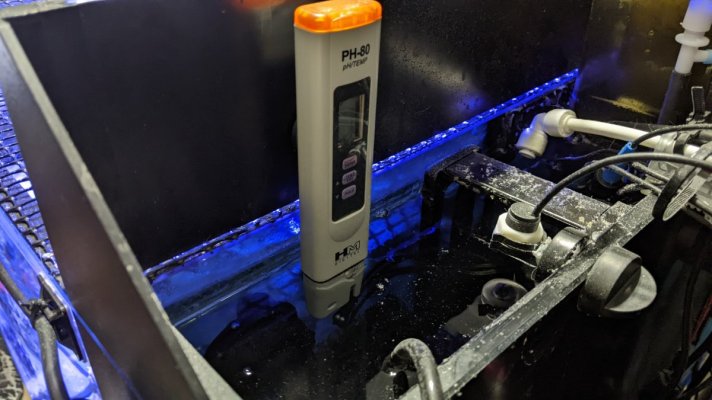
I keep a secondary pH probe mounted via magnet in the back of my AIO sump. Since I have an ATO, my water level is always true, so I mounted it in a way where the probe is always submerged.
 

Attachments

  • PXL_20220731_070929291.jpg
    PXL_20220731_070929291.jpg
    136 KB · Views: 78

TOP 10 Trending Threads

WHAT AMOUNT OF LIVE ROCK AND SAND SHOULD BE PRIORITIZED FOR OPTIMAL BIODIVERSITY/FILTRATION?

  • 100% live rock + bagged sand

    Votes: 50 27.2%
  • 100% dry rock + 100% live sand

    Votes: 57 31.0%
  • 50/50 live/dry rock, 50/50 live/bagged sand

    Votes: 40 21.7%
  • 75% live rock, 25% live sand

    Votes: 21 11.4%
  • 25% live rock, 75% live sand

    Votes: 16 8.7%
Back
Top