



reef-pi :: An opensource reef tank controller based on Raspberry Pi.

Free Phyto Promo
Spend $39+ → free 16oz Phyto · Use code FREEPHYTO at checkout · $16.99 value · Densest 6-species blend · Free shipping on every order · 100% live arrival guaranteed Spend $39+ → free 16oz Phyto · Use code FREEPHYTO at checkout · $16.99 value · Densest 6-species blend · Free shipping on every order · 100% live arrival guaranteed
Shop Now Code: FREEPHYTO
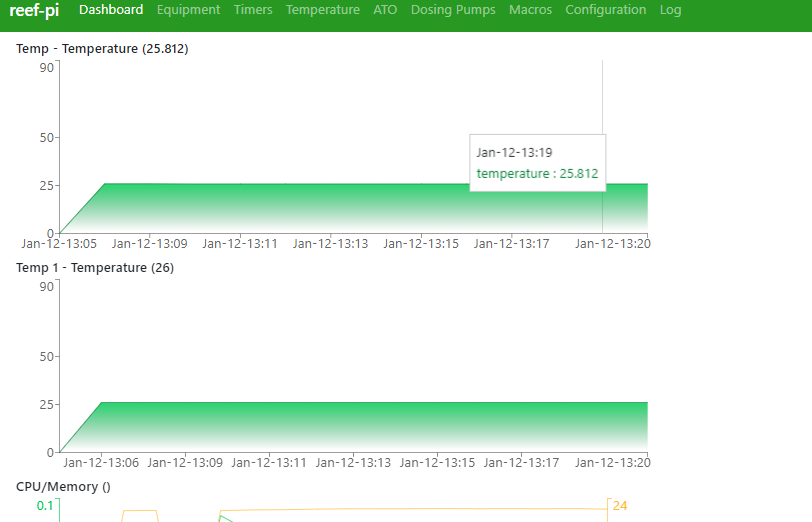
I decided to reinstal Raspbian and reef-pi 2.1, still not reading the temperature sensors, I have the sensors connected to around 8 ft of cat6 cable and an RJ45 socket and plug, I removed the cat6 wire and connected the sensors to the pi and it works!
Capture.PNG


So is cat6 cable not suitable for this type of project? If I recall correcty I think I had the same issue with the Arduino. Can I still use the cat6 if I use shorter lengths and where needed solder multi strand wire to the cat6?

Anyone care to comment?

 
I decided to reinstal Raspbian and reef-pi 2.1, still not reading the temperature sensors, I have the sensors connected to around 8 ft of cat6 cable and an RJ45 socket and plug, I removed the cat6 wire and connected the sensors to the pi and it works!

Capture.PNG


So is cat6 cable not suitable for this type of project? If I recall correcty I think I had the same issue with the Arduino. Can I still use the cat6 if I use shorter lengths and where needed solder multi strand wire to the cat6?

Anyone care to comment?
I dont know why the Cat 6 shouldnt work. Its meant for faster signals than the dallas one wire protocol. But from reading the ds18b20 datasheet, you may have to play with the resistor value some. The 4.7k resistor pulls the data line high when nothing communicates. On very short wire lengths 10k works. On long wire lengths 2.2k may be needed to overcome resistance and capacitance and pull the line up quick enough.
My sensor cables and are all 3 meters long and I have 3 sensors working with the 4.7k. I used ethernet connectors for jacks and everything works.
 
I dont know why the Cat 6 shouldnt work. Its meant for faster signals than the dallas one wire protocol. But from reading the ds18b20 datasheet, you may have to play with the resistor value some. The 4.7k resistor pulls the data line high when nothing communicates. On very short wire lengths 10k works. On long wire lengths 2.2k may be needed to overcome resistance and capacitance and pull the line up quick enough.
My sensor cables and are all 3 meters long and I have 3 sensors working with the 4.7k. I used ethernet connectors for jacks and everything works.

Thanks, i'll pick up some lower value resistors on Monday and try again. The RJ45 connectors are quite conveniet and cheap in comparison to anything else, good quality DB connectors are expensive here, basic ones are cheap and just not nice at all.
 
One quickie regarding the doser part, can I add more than 2? and what would be the jack number or is it related to which GPIO I choose? @Ranjib
 
Last edited:
Thanks, i'll pick up some lower value resistors on Monday and try again. The RJ45 connectors are quite conveniet and cheap in comparison to anything else, good quality DB connectors are expensive here, basic ones are cheap and just not nice at all.
Try again with just one sensor and double check that your jacks amd keystones are made up properly.

I use ethernet jacks for the same reason, I already have the tools, and no issues with shorting out the pi when hot plugging them like can happen with the audio jacks.
 
Thanks, i'll pick up some lower value resistors on Monday and try again. The RJ45 connectors are quite conveniet and cheap in comparison to anything else, good quality DB connectors are expensive here, basic ones are cheap and just not nice at all.
If you want to test, 2 4.7k resistors in parallel equals 2.35k, but I would go too low on that value(stay 1.5k or greater)
 
I mean the physical wiring on your ethernet jacks and plugs. Double check that and start with getting one sensor working

Ok understood, I wired them mysef and tested continuity so should have been correct, I did triple check.
 
Is there a way how to use i2c temperature sensor instead of the dsb1802? I'm referring to ezo temperature module by Atlas.
Thanks
Not currently. I may add support for this, since we have introduced a new hardware layer that makes doing such things easier.
 
I decided to reinstal Raspbian and reef-pi 2.1, still not reading the temperature sensors, I have the sensors connected to around 8 ft of cat6 cable and an RJ45 socket and plug, I removed the cat6 wire and connected the sensors to the pi and it works!

Capture.PNG


So is cat6 cable not suitable for this type of project? If I recall correcty I think I had the same issue with the Arduino. Can I still use the cat6 if I use shorter lengths and where needed solder multi strand wire to the cat6?

Anyone care to comment?
i dont think so, i think its circuit issue (short or continuity )
 
One quickie regarding the doser part, can I add more than 2? and what would be the jack number or is it related to which GPIO I choose? @Ranjib
With Pi, you are limited to only two pwm channels, hence theres a limit on only two dosing pumps. With pca9685 , that will be increased to 16
 
With Pi, you are limited to only two pwm channels, hence theres a limit on only two dosing pumps. With pca9685 , that will be increased to 16

So if I want to run 4 dosers I need to use a pca9685 and software no issues, right?

I think I have a working spare so I can give it a try.
 
Now I know what keystones are, I think i need to get a proper punching tool, 99% sure that's the issue.

Thanks guys!
Yes a punching tool helps...but you can try seating the wires with a small flat screwdriver, like an eyeglass type. Rj45 plugs take stranded or solid but most rj45 jacks are made for solid wire, so very small stranded wire sometimes get cut and dont make good connections when punched into the jacks.
When i did my temp sensors my hat has 3 wire connectors, of course they are stranded, to punch them into the jacks, i stripped them and tinned the ends to be punched in so when punched down into the jacks the jack had something to "bite" into, then I tested continuity before trying them out.
 
Yes a punching tool helps...but you can try seating the wires with a small flat screwdriver, like an eyeglass type. Rj45 plugs take stranded or solid but most rj45 jacks are made for solid wire, so very small stranded wire sometimes get cut and dont make good connections when punched into the jacks.
When i did my temp sensors my hat has 3 wire connectors, of course they are stranded, to punch them into the jacks, i stripped them and tinned the ends to be punched in so when punched down into the jacks the jack had something to "bite" into, then I tested continuity before trying them out.

Thank you, I'll give that a try, last resort I'll try changing the resistance.
 
It’s amazing how many connector issues we experience . This probably the biggest pain point across all the threads. So simple but still so failure prone :-/
 
It’s amazing how many connector issues we experience . This probably the biggest pain point across all the threads. So simple but still so failure prone :-/
As a hobbiest its difficult and expensive to have the proper tools to do the more reliable connectors. For the jst-xh on my hat board, I ordered premade pigtails and solder and tape/heatshrink them to the pigtail of the other type connector I need. Not worth investing in an expensive crimp tool, and the cheaper crimp tools are a big crapshoot.
I use ethernet jacks because I have good tools to make them. In the end, I like good old screw terminals but size become an issue.
So yes, you are right, connectors can be a trouble spot, and the first place to look when something doesn't work as planned.
 
As a hobbiest its difficult and expensive to have the proper tools to do the more reliable connectors. For the jst-xh on my hat board, I ordered premade pigtails and solder and tape/heatshrink them to the pigtail of the other type connector I need. Not worth investing in an expensive crimp tool, and the cheaper crimp tools are a big crapshoot.
I use ethernet jacks because I have good tools to make them. In the end, I like good old screw terminals but size become an issue.
So yes, you are right, connectors can be a trouble spot, and the first place to look when something doesn't work as planned.

Proper crimp tools for some connectors are easily $500+ for the hand tool. It’s absurd.

You can do passable crimps using the Engineer pliers from Japan. Engineer PA-09 Micro Connector Crimpers https://www.amazon.com/dp/B002AVVO7K/
 

ARE YOU READY TO CONFESS TO CRAZIEST, DUMBEST, FUNNIEST THING YOU’VE EVER DONE IN REEFING?

  • Yeah, I'll confess! (Share your story in the comments!)

    Votes: 26 65.0%
  • Nah, I'll keep mine a secret...(Don't be like that, share with the class!)

    Votes: 14 35.0%
Back
Top
Home
Post thread…
Market
What's new







