


reef-pi :: An opensource reef tank controller based on Raspberry Pi.

ph-jpg.991366


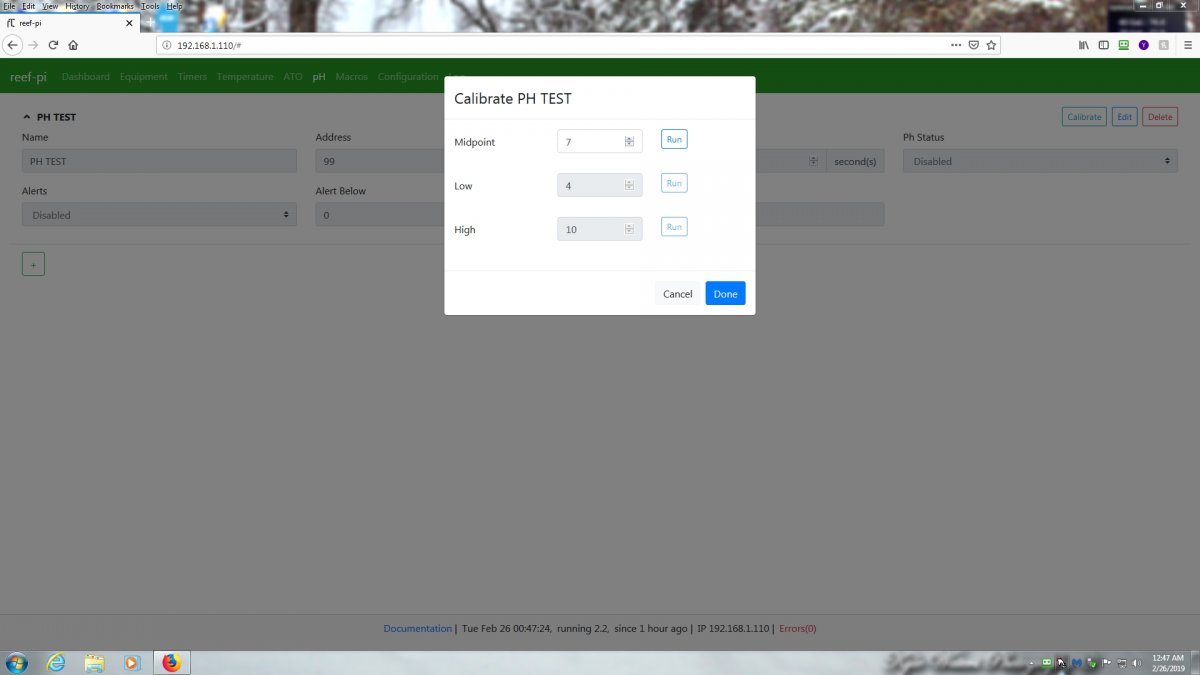
When calibrating the PH probe. The low and high will not drop down. Is this a problem with my build ? Low and high are greyed out.
Not that I aware of, let me check with 2.2
 
Temperature spike for the last 3 nights at the exact same time (2034 EST). Also, the temperature probes have been falling in and out, but not at the times of the spikes. I will replace the splitter as a means of troubleshooting, but the temp spikes are kinda alarming.

temp probe error.JPG


2034.JPG
Is this a genuine spike or sensor malfunction? Do you have any extra sensor ?
 
Well, I learned my lesson about Pi and VNC tonight. Went to finish up configuration and logged into VNC which basically killed all processing on the Pi. After dismantling the whole thing down to barebones equipment I finally found the culprit. SSH it is from now on.
Pi zero ? Or pi 3 ?
 
60 Second interval. It's been good until this weekend. The reef-pi has been restarted a couple of times, and I have the temperature probes, both with the 3.5mm jack, but going into a basic headphone splitter.
Why reef-pi was restarted ? Was it induced by you ? Or something unknown ?
 
Pi zero ? Or pi 3 ?

It was a pi 3 A+ and it would run fine until I logged in remotely through VNC then everything would hang up. I hooked it back up to a monitor and keyboard with the same results as soon as I connected remotely it would start to hang at the desktop being unable to use the Remote viewer app or the native desktop of the pi. I tried both RealVNC and TightVNC servers they both did the same thing.
 
It was a pi 3 A+ and it would run fine until I logged in remotely through VNC then everything would hang up. I hooked it back up to a monitor and keyboard with the same results as soon as I connected remotely it would start to hang at the desktop being unable to use the Remote viewer app or the native desktop of the pi. I tried both RealVNC and TightVNC servers they both did the same thing.

Keep in mind the 3A+ has half the memory of a 3b, I also run a 3A+ but do not run the desktop version. There are other options like x2go and NX (No Machine) that may work better but with only 512Mb of memory I would only connect via SSH, it will consume much less resources. If you want to test some more with remote desktop I would double your swap space, my guess is your running out of memory, but would have to look at the logs to verify what exactly is taking place.
 
Last edited:
Keep in mind the 3A+ has half the memory of a 3b, I also run a 3A+ but do not run the desktop version. There are other options like x2go and NX (No Machine) that may work better but with only 512Mb of memory I would only connect via SSH, it will consume much less resources. If you want to test some more with remote desktop I would double your swap space, my guess is your running out of memory, but would have to look at the logs to verify what exactly is taking place.
ooh, thats a good callout, i forgot that and assumed its same as pi3, except without the usb and rj45 ports..
 
I did not realize that was the case and it makes since now. Reef-pi is working fine now and I am okay using ssh so I will just let it be. I have a pi zero on the way so I have something to play with and learn more about pi programming. Might swap the two pi out when it gets here.

Is there anyway to copy all my reef-pi settings between the two devices or should I just recreate everything when the zero comes in?
 
I did not realize that was the case and it makes since now. Reef-pi is working fine now and I am okay using ssh so I will just let it be. I have a pi zero on the way so I have something to play with and learn more about pi programming. Might swap the two pi out when it gets here.

Is there anyway to copy all my reef-pi settings between the two devices or should I just recreate everything when the zero comes in?

Funny you should ask, I am working on something for just that, give me a couple of days and I should have something posted. Will try to cover a windoze process which will take me longer to documemt vs a pure Linux process.
 
Last edited:
So here are the two main files that you would need to copy to a remote system on a routine basis in order to restore reef-pi:

-rw------- 1 root root 1286144 Feb 27 21:19 /var/lib/reef-pi/reef-pi.db
-rwxr-xr-x 1 root root 1638 Jan 4 19:20 /boot/config.txt

Now a couple of questions are there any other files that would be beneficial in addition to these, if so let me know. The other question is I would like to keep things simple, the idea is we would like to have a cron type job that copies the files to a remote system. There are a lot of ways of doing this, I would assume that most users will be windows based, but I believe an easier target would be something like a pi zero or something similar. Open to suggestions for target destinations, with the idea of keeping it simple for anyone to setup. Let me here some suggestions and I will see what I can put together based on the input.

Thanks :)
 
So here are the two main files that you would need to copy to a remote system on a routine basis in order to restore reef-pi:

-rw------- 1 root root 1286144 Feb 27 21:19 /var/lib/reef-pi/reef-pi.db
-rwxr-xr-x 1 root root 1638 Jan 4 19:20 /boot/config.txt

Now a couple of questions are there any other files that would be beneficial in addition to these, if so let me know. The other question is I would like to keep things simple, the idea is we would like to have a cron type job that copies the files to a remote system. There are a lot of ways of doing this, I would assume that most users will be windows based, but I believe an easier target would be something like a pi zero or something similar. Open to suggestions for target destinations, with the idea of keeping it simple for anyone to setup. Let me here some suggestions and I will see what I can put together based on the input.

Thanks :)
Target: NAS through SMB or SSH?
 
Target: NAS through SMB or SSH?

Well that's one of the obstacles, since any remote connection will require passwords for login unless we use SSH keys. Not a fan of storing passwords in scripts or in files for execution.

Still mulling things in my head, the easiest would be to have an additional USB thumb drive and write the files locally. That would be easy for most of the pi's except the zeros since they are micro USB.

:)
 
Well that's one of the obstacles, since any remote connection will require passwords for login unless we use SSH keys. Not a fan of storing passwords in scripts or in files for execution.

Still mulling things in my head, the easiest would be to have an additional USB thumb drive and write the files locally. That would be easy for most of the pi's except the zeros since they are micro USB.

:)
They make microusb thumb drives
 
My vote would be for a thumb drive. I was planning on coming up with a way to leave a thumb drive plugged in and have it auto backup every few months or coming up with a way to send it to google docs but then there is the authentication issue you mentioned. Its on my list of things to do and have not gotten around to it. lol
 
Sorry for butting in out of nowhere but it might be easier to tie into the api provided by dropbox or google drive. It would be pretty simple to add that as the backup target, and the user would just use that auth system vs. trying to roll one independently. Just zip it up and send it with a cron entry.

I stumbled upon this project on accident. After I homegrew something similar using node-red and python on the RPi.
 
So here are the two main files that you would need to copy to a remote system on a routine basis in order to restore reef-pi:

-rw------- 1 root root 1286144 Feb 27 21:19 /var/lib/reef-pi/reef-pi.db
-rwxr-xr-x 1 root root 1638 Jan 4 19:20 /boot/config.txt

Now a couple of questions are there any other files that would be beneficial in addition to these, if so let me know. The other question is I would like to keep things simple, the idea is we would like to have a cron type job that copies the files to a remote system. There are a lot of ways of doing this, I would assume that most users will be windows based, but I believe an easier target would be something like a pi zero or something similar. Open to suggestions for target destinations, with the idea of keeping it simple for anyone to setup. Let me here some suggestions and I will see what I can put together based on the input.

Thanks :)
thats all i can think of. Its wise to capture the pi version and raspbian version (lsb_release/uname)
 

ARE YOU READY TO CONFESS TO CRAZIEST, DUMBEST, FUNNIEST THING YOU’VE EVER DONE IN REEFING?

  • Yeah, I'll confess! (Share your story in the comments!)

    Votes: 25 64.1%
  • Nah, I'll keep mine a secret...(Don't be like that, share with the class!)

    Votes: 14 35.9%
Back
Top
Home
Post thread…
Market
What's new




