The Wrasse Lover's Thread!

Out of curiosity, why do you think this?
Is it mainly because Gomphosus and Thalassoma are closely related genera? Because Gomphosus has never had Thalassoma as a synonym.
Here’s the Thalassoma/Gomphosus family tree :)
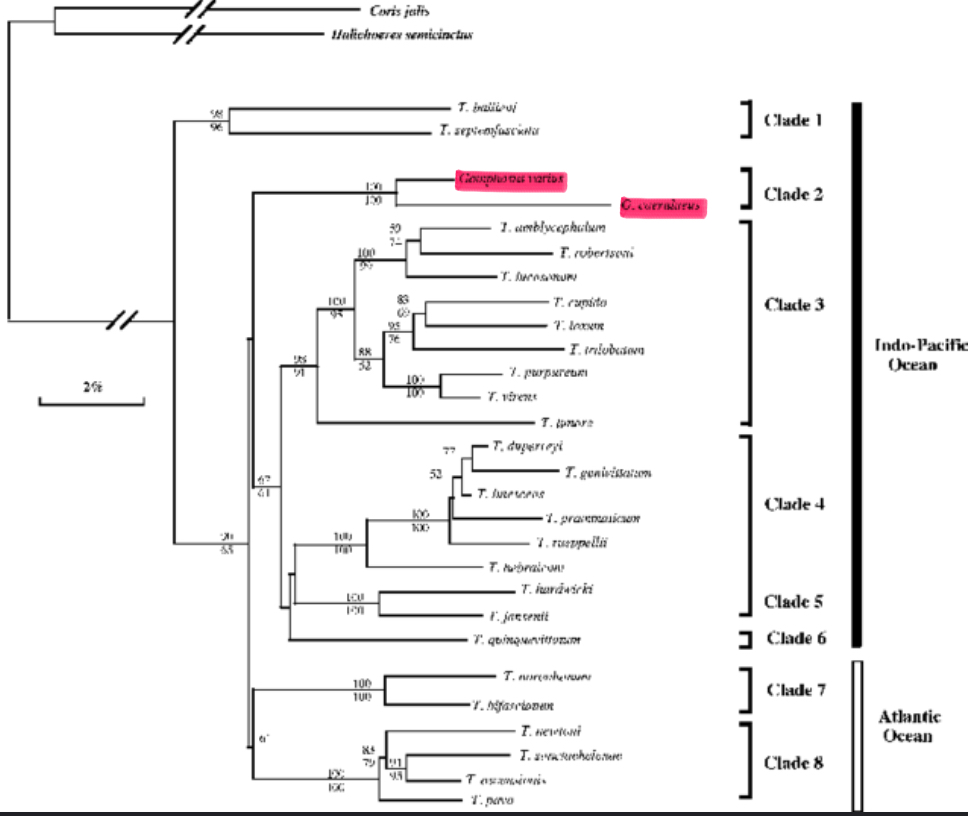
IMG_6078.jpeg


I’m still tempted to see how easy it is to do a family tree for the reef safe (arguably nicer) genera.

Have fun if you do try. Issue is the Halichoeres and Coris genera are an absolute mess
 
Have fun if you do try. Issue is the Halichoeres and Coris genera are an absolute mess
If we go by @Cael Gallery ‘s theory - several species from those two genera should move into the other as most of the time, those species are incredibly close in relation (I mean, H. chloropterus is closely related to C. batuensis).
 
If we go by @Cael Gallery ‘s theory - several species from those two genera should move into the other as most of the time, those species are incredibly close in relation (I mean, H. chloropterus is closely related to C. batuensis).
Yeah. All the dna tests seem to suggest that the current organization is wrong. Its pretty obvious too. This Coris pictoides is quite obviously more Halichoeres then Coris gaimard.
IMG_2415.jpeg
 
Have fun if you do try. Issue is the Halichoeres and Coris genera are an absolute mess
I was wondering when you might show. Phylogenetic trees must be like your bat signal.
 
If we go by @Cael Gallery ‘s theory - several species from those two genera should move into the other as most of the time, those species are incredibly close in relation (I mean, H. chloropterus is closely related to C. batuensis).
Yes, both Halichoeres and Coris are what is referred to in taxonomy as polyphyletic, meaning that the species contained within that genus are descended from more than one common ancestor. As opposed to Gomphosus which shows that all species contained there descended from one common ancestor (clade 1), meaning that group is Monophyletic. And notice i said Gomphosus, that's because the name Gomphosus actually precedes Thalassoma meaning that whenever the 2 genera are revised and synonymised, Gomphosus will be the new name. So we'll end up with things like Gomphosus lutescens and Gomphosus lunare. I actually have a background in taxonomy, specifically i'm studying arachnology, so this is all pretty interesting to me. Even though i'm a bit of a novice about fishes in captivity, the taxonomic or ichthyology side comes pretty naturally!
 
Many years ago Hunter told me choats are sensitive to alk swings that coral won’t flinch at. All these years I wondered what is it about alk swings and choats have in common. Past couple weeks I been dosing alk to raise it. First dose raises .4 DKH and choats swam strange and hid along with little interest in food or me around the tank for few days. Dose number 2 I raised .3 but in two doses. Choats acted similar but recovered quick. Dose number 3 raised tank .2 and it was divided in multiple doses Sshe is much better but little off. Never noticed it with my other 3 choats. Maybe coincidence but I see a pattern. I don’t have a ph probe hooked up yet and I’m using calcium bicarbonate
 
Many years ago Hunter told me choats are sensitive to alk swings that coral won’t flinch at. All these years I wondered what is it about alk swings and choats have in common. Past couple weeks I been dosing alk to raise it. First dose raises .4 DKH and choats swam strange and hid along with little interest in food or me around the tank for few days. Dose number 2 I raised .3 but in two doses. Choats acted similar but recovered quick. Dose number 3 raised tank .2 and it was divided in multiple doses Sshe is much better but little off. Never noticed it with my other 3 choats. Maybe coincidence but I see a pattern. I don’t have a ph probe hooked up yet and I’m using calcium bicarbonate
Very interesting. But that would mean the choats has some defect or difference in a biologic process that the other macro’s don’t have? Might be a stretch. However we know they can be harder to keep than the others. Many questions.
 
Very interesting. But that would mean the choats has some defect or difference in a biologic process that the other macro’s don’t have? Might be a stretch. However we know they can be harder to keep than the others. Many questions.
So many thoughts. I suspect she has flukes or I should say something bothering her gills. Maybe adding alk irritates it more.
 
Hello Wrasse friends!

Question, i currently have a ornate leopard wrasse in my 80g 4 foot tank. He is a juvenile about 2". My LFS recently got some naokako wrasses in stock, do you think there would be aggression between him and the leopard?

Other fish i have are 2 ocellaris, 1 royal gramma, 1 fire goby, 1 pajama cardinal. All get along well.
 
Hello Wrasse friends!

Question, i currently have a ornate leopard wrasse in my 80g 4 foot tank. He is a juvenile about 2". My LFS recently got some naokako wrasses in stock, do you think there would be aggression between him and the leopard?

Other fish i have are 2 ocellaris, 1 royal gramma, 1 fire goby, 1 pajama cardinal. All get along well.
I've never seen any aggression between my blue star leopard and any other fish, including a brunneus fairy, exquisite fairy and a Carpenter's flasher. Naokoe are meant to be a bit more aggressive than the ones I mentioned, though, but I wouldn't expect aggression from the leopard.
 
Hello Wrasse friends!

Question, i currently have a ornate leopard wrasse in my 80g 4 foot tank. He is a juvenile about 2". My LFS recently got some naokako wrasses in stock, do you think there would be aggression between him and the leopard?

Other fish i have are 2 ocellaris, 1 royal gramma, 1 fire goby, 1 pajama cardinal. All get along well.
I have a naoko with my ornate and no issues
 

ARE YOU READY TO CONFESS TO CRAZIEST, DUMBEST, FUNNIEST THING YOU’VE EVER DONE IN REEFING?

  • Yeah, I'll confess! (Share your story in the comments!)

    Votes: 17 56.7%
  • Nah, I'll keep mine a secret...(Don't be like that, share with the class!)

    Votes: 13 43.3%
Back
Top
Home
Post thread…
Market
What's new