reef-pi :: An opensource reef tank controller based on Raspberry Pi.

OP
OP
Ranjib

Ranjib

7500 Club Member
View Badges
Joined
Apr 16, 2016
Messages
9,876
Reaction score
16,680
Location
Pleasant Hill, Concord
Rating - 0%
0   0   0
Thanks for the answer.
These errors are from UI (configuration --> Errors).
I know that feed names can't contain space... I have named them without any space.
Can you post a screen shot? The UI should show the feedname.
 

Freccialata

Community Member
View Badges
Joined
Jan 31, 2020
Messages
54
Reaction score
97
Location
Rome (Italy)
Rating - 0%
0   0   0
Can you post a screen shot? The UI should show the feedname.

Sure.
Thank you for your support.

Schermata 2020-04-12 alle 11.24.54.png Schermata 2020-04-12 alle 11.36.42.png
 
Last edited:

drbogger

Active Member
View Badges
Joined
Apr 24, 2019
Messages
165
Reaction score
126
Location
Ballston Spa, New York
Rating - 0%
0   0   0
How do I setup Automatic Water Changes to use ATO Sensors?

I have 2 Optical Sensors, one as high water level, and one as low water level. (The low water level sensor is only used for water changes).

I have 2 pumps, one drain pump, and one fill pump. (Both are listed under the "Equipment Tab")

I want to trigger the water change from a "timer", and I want the process to be as follows:

1. Turn on the "Drain Pump" to drain the water until water level triggers the "low water level" sensor.
2. Then turn on the "Fill Pump" until the water level triggers the "high water level" sensor.

How do I go about doing this?

My questions always get left behind :confused:
 

Michael Lane

Well-Known Member
View Badges
Joined
Aug 11, 2018
Messages
677
Reaction score
1,121
Rating - 0%
0   0   0
Well I figured out the ribbon cable, helps to send the #9 pin (v+) to #5 on the connector end, once you do that it all works, such a Doh! moment. Sorry to clutter up the forum for real issues, now to go figure out what to do about ATO and all my other pressing issues.

@Michael Lane I am looking at the Mars aqua for lighting, I know I saw some posts that detailed the connector piece in the lights but unable to find it. If you have that handy I would appreciate it, I think you also used mini xlr connectors for the light portion also, is that correct?

Hope everyone is staying safe and doing well!
:)

I think I need to go start my build thread, here is close to a latest picture, I have the back painted black now but close to where I am at the moment.
IMG_20200403_164122.jpg
That looks really good, especially if you'll be able to use that drawer.

I've used a bunch of the mini-xlr connectors. I like them, but they are a bit expensive. I'm not sure I understand what yo mean about the Mars Aqua light connectors, but the images in this post might show what you are looking for.
 

Michael Lane

Well-Known Member
View Badges
Joined
Aug 11, 2018
Messages
677
Reaction score
1,121
Rating - 0%
0   0   0
Well I figured out the ribbon cable, helps to send the #9 pin (v+) to #5 on the connector end, once you do that it all works, such a Doh! moment. Sorry to clutter up the forum for real issues, now to go figure out what to do about ATO and all my other pressing issues.

@Michael Lane I am looking at the Mars aqua for lighting, I know I saw some posts that detailed the connector piece in the lights but unable to find it. If you have that handy I would appreciate it, I think you also used mini xlr connectors for the light portion also, is that correct?

Hope everyone is staying safe and doing well!
:)

I think I need to go start my build thread, here is close to a latest picture, I have the back painted black now but close to where I am at the moment.
IMG_20200403_164122.jpg
There are also 2 kinds of DB9 adapters and they have different pin-outs on the female side. This is the kind that I've used.
1586707521139.png


The smaller connectors doesn't work unless you pop out some pins and reconnect them differently. I can't remember which it was, but I can try to dig it back out if you need.
1586707628255.png
 

bishoptf

Valuable Member
View Badges
Joined
Jan 1, 2019
Messages
1,409
Reaction score
1,726
Location
Missouri
Rating - 0%
0   0   0
That looks really good, especially if you'll be able to use that drawer.

I've used a bunch of the mini-xlr connectors. I like them, but they are a bit expensive. I'm not sure I understand what yo mean about the Mars Aqua light connectors, but the images in this post might show what you are looking for.

Yup that was the one I was looking for, I am going to go with JST-SM connectors vs the mini xlr, I almost went with Midi and still might change my mind but my thought was to have a female to female connector back to back through a small hole, planning on doing that with my connections coming out of my reef-pi. I purchased a JST crimper and SM and XH connectors so I can make jumpers a certain length etc. Will see how it works out, can always go to plan B or C...lol

:)
 

bishoptf

Valuable Member
View Badges
Joined
Jan 1, 2019
Messages
1,409
Reaction score
1,726
Location
Missouri
Rating - 0%
0   0   0
There are also 2 kinds of DB9 adapters and they have different pin-outs on the female side. This is the kind that I've used.
1586707521139.png


The smaller connectors doesn't work unless you pop out some pins and reconnect them differently. I can't remember which it was, but I can try to dig it back out if you need.
1586707628255.png

That picture makes a lot more sense I though I had fried the uln2803 etc, I ended up just re-soldering the end to move that one connection, never figured out how to take apart an IDC connector, once they go together they are done. I have some new shells and connectors to customize length, planning on just soldering it up, bought a new small gauge wire stripper...Whoo hooo, more tools :)
 

robsworld78

Valuable Member
View Badges
Joined
Feb 14, 2020
Messages
1,029
Reaction score
1,293
Location
Edmonton, Canada
Rating - 0%
0   0   0
SHT31D Humidity sensor . Work in progress driver in reef-pi. It exposes two analog inputs, channel 0 represent temperature (in Celsius) and channel 1 relative humidity.

sht31d.png

That sensor is pretty expensive, have you thought about the DHT22?

Also the less I2C devices the better everyone will be. ;)
 

robsworld78

Valuable Member
View Badges
Joined
Feb 14, 2020
Messages
1,029
Reaction score
1,293
Location
Edmonton, Canada
Rating - 0%
0   0   0
How do I setup Automatic Water Changes to use ATO Sensors?

I have 2 Optical Sensors, one as high water level, and one as low water level. (The low water level sensor is only used for water changes).

I have 2 pumps, one drain pump, and one fill pump. (Both are listed under the "Equipment Tab")

I want to trigger the water change from a "timer", and I want the process to be as follows:

1. Turn on the "Drain Pump" to drain the water until water level triggers the "low water level" sensor.
2. Then turn on the "Fill Pump" until the water level triggers the "high water level" sensor.

How do I go about doing this?

Here's an example I was shown from @Des Westcott, he's the macro specialist and teaching me. :)

I'll try and explain as I understand it. This example uses a low/high level sensor to control separate pumps just like you're after. It also has an ATO sensor that gets disabled but you can ignore that.

I assume you setup your two sensors in the ATO tab, in this example that is 'AWC Out' (low level) and 'AWC in' (high level). When you setup these 'ATO' sensors have the low level set to control the drain pump and the high level should control the fill pump.

Sounds like you have your pumps setup correctly.

Now you need to create a 'Macro' to control everything. You might want to create two, call one 'Manual AWC' and the other 'Auto AWC'. There's a slight "glitch" with macros, if you want to use a timer to trigger the macro you need to setup the 'Steps' in reverse and set the 'Reversible' drop down box to 'Yes'. This is why you need 2 macros so you can better test it and run the AWC manually.

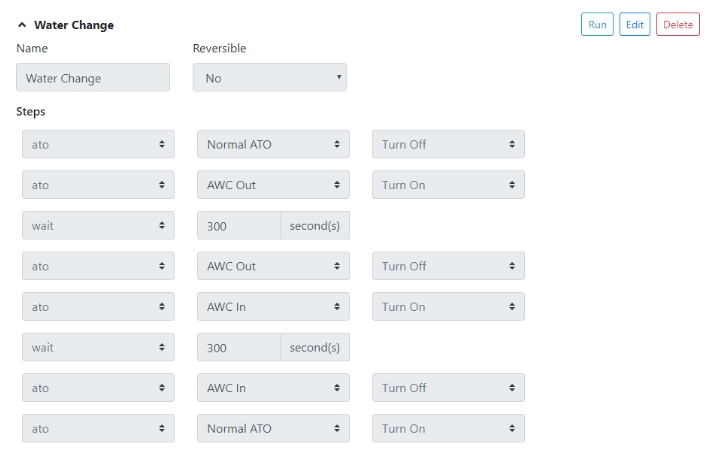
Let's go through each 'Steps' in the macro.
  1. The first step is optional and sounds like it doesn't apply to you but if you did have an ATO sensor you would first need to disable this sensor while the AWC runs.
  2. Now you want to enable the low level sensor (AWC Out) which will be sensing water. As soon as you 'Turn On' this sensor the pump it's controlling should turn on and water will start draining. If your sensor turns the pump on when no water is sensed, aka backwards, you need to go to the sensors 'Connector' and change the 'Reverse' option.
  3. Now you add a 'Wait' period to your macro, this is the longest you want you drain pump to run and should turn off your pump even if the lower sensor fails. The idea is the macro allows the drain system to run for a maximum of 300 seconds or whatever you choose. The next step won't run until this 'Wait' period expires.
  4. Now you 'Turn Off' the AWC Out sensor as it's no longer needed as your water has been drained. You could insert an extra step after this to turn off the actual drain pump, basically a make sure its off kind of thing.
  5. Now you 'Turn On' the AWC In sensor which is the high level sensor. Once this turns on it will startup the refill pump as it's not sensing any water. If your sensor turns the pump on when water is sensed, aka backwards, you need to go to the sensors 'Connector' and change the 'Reverse' option.
  6. Now you add another 'Wait' period, again this is the maximum you want the refill pump to run and should be set longer than it typically takes to refill your tank as you want the sensor to turn the pump off but obviously not long enough to cause a flood if the high level sensor failed. The next step won't run until this 'Wait' period expires.
  7. Now you can add a 'Step' to 'Turn Off' the high level sensor as the water change is complete. You could insert an extra step after this step to turn off the actual refill pump, basically a make sure its off kind of thing.
  8. And finally if you do have an ATO sensor setup as well you can turn this back on so your ATO will run as normal again.
macro_AWC.jpg

Hope this helps, you might have to read it a few times as I typically need to rewrite things about 3 times before others can understand my gibberish. :)

The important thing to remember is the above represents running the macro manually. To run this macro via a timer you need to create the 'Steps' in reverse and set 'Reversible' to 'Yes', don't forget this or you will be chasing your tail.

 

Des Westcott

Well-Known Member
View Badges
Joined
May 29, 2018
Messages
646
Reaction score
1,025
Location
Durban - South Africa
Rating - 0%
0   0   0
Here's an example I was shown from @Des Westcott, he's the macro specialist and teaching me. :)

I'll try and explain as I understand it. This example uses a low/high level sensor to control separate pumps just like you're after. It also has an ATO sensor that gets disabled but you can ignore that.

I assume you setup your two sensors in the ATO tab, in this example that is 'AWC Out' (low level) and 'AWC in' (high level). When you setup these 'ATO' sensors have the low level set to control the drain pump and the high level should control the fill pump.

Sounds like you have your pumps setup correctly.

Now you need to create a 'Macro' to control everything. You might want to create two, call one 'Manual AWC' and the other 'Auto AWC'. There's a slight "glitch" with macros, if you want to use a timer to trigger the macro you need to setup the 'Steps' in reverse and set the 'Reversible' drop down box to 'Yes'. This is why you need 2 macros so you can better test it and run the AWC manually.

Let's go through each 'Steps' in the macro.
  1. The first step is optional and sounds like it doesn't apply to you but if you did have an ATO sensor you would first need to disable this sensor while the AWC runs.
  2. Now you want to enable the low level sensor (AWC Out) which will be sensing water. As soon as you 'Turn On' this sensor the pump it's controlling should turn on and water will start draining. If your sensor turns the pump on when no water is sensed, aka backwards, you need to go to the sensors 'Connector' and change the 'Reverse' option.
  3. Now you add a 'Wait' period to your macro, this is the longest you want you drain pump to run and should turn off your pump even if the lower sensor fails. The idea is the macro allows the drain system to run for a maximum of 300 seconds or whatever you choose. The next step won't run until this 'Wait' period expires.
  4. Now you 'Turn Off' the AWC Out sensor as it's no longer needed as your water has been drained. You could insert an extra step after this to turn off the actual drain pump, basically a make sure its off kind of thing.
  5. Now you 'Turn On' the AWC In sensor which is the high level sensor. Once this turns on it will startup the refill pump as it's not sensing any water. If your sensor turns the pump on when water is sensed, aka backwards, you need to go to the sensors 'Connector' and change the 'Reverse' option.
  6. Now you add another 'Wait' period, again this is the maximum you want the refill pump to run and should be set longer than it typically takes to refill your tank as you want the sensor to turn the pump off but obviously not long enough to cause a flood if the high level sensor failed. The next step won't run until this 'Wait' period expires.
  7. Now you can add a 'Step' to 'Turn Off' the high level sensor as the water change is complete. You could insert an extra step after this step to turn off the actual refill pump, basically a make sure its off kind of thing.
  8. And finally if you do have an ATO sensor setup as well you can turn this back on so your ATO will run as normal again.
macro_AWC.jpg

Hope this helps, you might have to read it a few times as I typically need to rewrite things about 3 times before others can understand my gibberish. :)

The important thing to remember is the above represents running the macro manually. To run this macro via a timer you need to create the 'Steps' in reverse and set 'Reversible' to 'Yes', don't forget this or you will be chasing your tail.


Hey @robsworld78 . I think you've summed it up very well there. Thank you. @drbogger I somehow missed your original post as well, otherwise would have responded. TBH, I haven't looked at the forum this whole weekend. But what you'r trying to accomplish sounds like exactly what I have running.
 

robsworld78

Valuable Member
View Badges
Joined
Feb 14, 2020
Messages
1,029
Reaction score
1,293
Location
Edmonton, Canada
Rating - 0%
0   0   0
Hey @robsworld78 . I think you've summed it up very well there. Thank you. @drbogger I somehow missed your original post as well, otherwise would have responded. TBH, I haven't looked at the forum this whole weekend. But what you'r trying to accomplish sounds like exactly what I have running.

Helps to have a good teacher. ;) When I first played with Reef-pi I was impressed with the macros, then I tried setting them up in real life and was not so impressed as I couldn't get anything I wanted to work, then you came along and now I'm very impressed with macros. I'm going to write a mini manual only on macros as I'm certain many are struggling with them. Only thing really missing from macros is being able to trigger a dosing pump, hint hint...
 

Des Westcott

Well-Known Member
View Badges
Joined
May 29, 2018
Messages
646
Reaction score
1,025
Location
Durban - South Africa
Rating - 0%
0   0   0
Helps to have a good teacher. ;) When I first played with Reef-pi I was impressed with the macros, then I tried setting them up in real life and was not so impressed as I couldn't get anything I wanted to work, then you came along and now I'm very impressed with macros. I'm going to write a mini manual only on macros as I'm certain many are struggling with them. Only thing really missing from macros is being able to trigger a dosing pump, hint hint...

You;re too kind :eek:

But you could have a "minor macro" that administers your dose and then any Macro / Timer can trigger that.
 
OP
OP
Ranjib

Ranjib

7500 Club Member
View Badges
Joined
Apr 16, 2016
Messages
9,876
Reaction score
16,680
Location
Pleasant Hill, Concord
Rating - 0%
0   0   0
Here's an example I was shown from @Des Westcott, he's the macro specialist and teaching me. :)

I'll try and explain as I understand it. This example uses a low/high level sensor to control separate pumps just like you're after. It also has an ATO sensor that gets disabled but you can ignore that.

I assume you setup your two sensors in the ATO tab, in this example that is 'AWC Out' (low level) and 'AWC in' (high level). When you setup these 'ATO' sensors have the low level set to control the drain pump and the high level should control the fill pump.

Sounds like you have your pumps setup correctly.

Now you need to create a 'Macro' to control everything. You might want to create two, call one 'Manual AWC' and the other 'Auto AWC'. There's a slight "glitch" with macros, if you want to use a timer to trigger the macro you need to setup the 'Steps' in reverse and set the 'Reversible' drop down box to 'Yes'. This is why you need 2 macros so you can better test it and run the AWC manually.

Let's go through each 'Steps' in the macro.
  1. The first step is optional and sounds like it doesn't apply to you but if you did have an ATO sensor you would first need to disable this sensor while the AWC runs.
  2. Now you want to enable the low level sensor (AWC Out) which will be sensing water. As soon as you 'Turn On' this sensor the pump it's controlling should turn on and water will start draining. If your sensor turns the pump on when no water is sensed, aka backwards, you need to go to the sensors 'Connector' and change the 'Reverse' option.
  3. Now you add a 'Wait' period to your macro, this is the longest you want you drain pump to run and should turn off your pump even if the lower sensor fails. The idea is the macro allows the drain system to run for a maximum of 300 seconds or whatever you choose. The next step won't run until this 'Wait' period expires.
  4. Now you 'Turn Off' the AWC Out sensor as it's no longer needed as your water has been drained. You could insert an extra step after this to turn off the actual drain pump, basically a make sure its off kind of thing.
  5. Now you 'Turn On' the AWC In sensor which is the high level sensor. Once this turns on it will startup the refill pump as it's not sensing any water. If your sensor turns the pump on when water is sensed, aka backwards, you need to go to the sensors 'Connector' and change the 'Reverse' option.
  6. Now you add another 'Wait' period, again this is the maximum you want the refill pump to run and should be set longer than it typically takes to refill your tank as you want the sensor to turn the pump off but obviously not long enough to cause a flood if the high level sensor failed. The next step won't run until this 'Wait' period expires.
  7. Now you can add a 'Step' to 'Turn Off' the high level sensor as the water change is complete. You could insert an extra step after this step to turn off the actual refill pump, basically a make sure its off kind of thing.
  8. And finally if you do have an ATO sensor setup as well you can turn this back on so your ATO will run as normal again.
macro_AWC.jpg

Hope this helps, you might have to read it a few times as I typically need to rewrite things about 3 times before others can understand my gibberish. :)

The important thing to remember is the above represents running the macro manually. To run this macro via a timer you need to create the 'Steps' in reverse and set 'Reversible' to 'Yes', don't forget this or you will be chasing your tail.

This should go in the docs :-)
 

robsworld78

Valuable Member
View Badges
Joined
Feb 14, 2020
Messages
1,029
Reaction score
1,293
Location
Edmonton, Canada
Rating - 0%
0   0   0
You;re too kind :eek:

But you could have a "minor macro" that administers your dose and then any Macro / Timer can trigger that.

I can't get it to work. I setup a doser, go to calibrate, hit run and it does what it should.

If I create a macro and select that doser it only enable/disables it, doesn't actually make it run like a calibration.

This should go in the docs :)

Yeah it will, @Des Westcott and @cnidus have been helping me out which is great.
 
OP
OP
Ranjib

Ranjib

7500 Club Member
View Badges
Joined
Apr 16, 2016
Messages
9,876
Reaction score
16,680
Location
Pleasant Hill, Concord
Rating - 0%
0   0   0
That sensor is pretty expensive, have you thought about the DHT22?

Also the less I2C devices the better everyone will be. ;)
DHT22 is in my plan as well. I prefer i2c because it requires no additional circuit and software logic beyond the sensor's protocol. The price is generally not an issue if its only 5-10$ difference. If its more precise, its better (within 5-10$ margin). When I integrate a new thing my general goal is to get an end to end flow going first. In this case getting to see humidity trend, correlating it with other signals to make sure this makes sense.,. check general stability (software wise) etc. I find i2c based sensor pretty handy. They are generally better quality and software, electronics requirements are lesser. i have my eyes on the platinum temp probe as well.
 

Des Westcott

Well-Known Member
View Badges
Joined
May 29, 2018
Messages
646
Reaction score
1,025
Location
Durban - South Africa
Rating - 0%
0   0   0
I can't get it to work. I setup a doser, go to calibrate, hit run and it does what it should.

If I create a macro and select that doser it only enable/disables it, doesn't actually make it run like a calibration.


Yeah it will, @Des Westcott and @cnidus have been helping me out which is great.

OK. I haven't played with the dosing function at all so it was just a guess. But if you just controlled a dosing pump like a piece of equipment it would work. But then you lose the additional dosing functionality. I might be speaking out of turn here, but what you describe sounds like a glitch not unlike the macros only running in reverse when triggered by a timer or macro. Just a guess though, but sounds solveable. Or maybe a "manual dose" feature needs to be introduced........ somehow.

It's easy to have ideas when you're not the one that actually has to make them work :) :) :)
 

robsworld78

Valuable Member
View Badges
Joined
Feb 14, 2020
Messages
1,029
Reaction score
1,293
Location
Edmonton, Canada
Rating - 0%
0   0   0
DHT22 is in my plan as well. I prefer i2c because it requires no additional circuit and software logic beyond the sensor's protocol. The price is generally not an issue if its only 5-10$ difference. If its more precise, its better (within 5-10$ margin). When I integrate a new thing my general goal is to get an end to end flow going first. In this case getting to see humidity trend, correlating it with other signals to make sure this makes sense.,. check general stability (software wise) etc. I find i2c based sensor pretty handy. They are generally better quality and software, electronics requirements are lesser. i have my eyes on the platinum temp probe as well.

I2C is great but IMO should be avoid as much as possible because technically it was designed so the signal never leaves the PCB, wires are it's worse enemy. I've gotten carried away with I2C devices in the past and it caused all kinds of reliability issues because the signal is very weak and prone to noise. Buffers are great but only do some much and just a bandaid.
 
OP
OP
Ranjib

Ranjib

7500 Club Member
View Badges
Joined
Apr 16, 2016
Messages
9,876
Reaction score
16,680
Location
Pleasant Hill, Concord
Rating - 0%
0   0   0
I can't get it to work. I setup a doser, go to calibrate, hit run and it does what it should.

If I create a macro and select that doser it only enable/disables it, doesn't actually make it run like a calibration.


Yeah it will, @Des Westcott and @cnidus have been helping me out which is great.
I cant thank you all enough for this effort. Documentation is probably the biggest hurdle for new reef-pi users
 

robsworld78

Valuable Member
View Badges
Joined
Feb 14, 2020
Messages
1,029
Reaction score
1,293
Location
Edmonton, Canada
Rating - 0%
0   0   0
OK. I haven't played with the dosing function at all so it was just a guess. But if you just controlled a dosing pump like a piece of equipment it would work. But then you lose the additional dosing functionality. I might be speaking out of turn here, but what you describe sounds like a glitch not unlike the macros only running in reverse when triggered by a timer or macro. Just a guess though, but sounds solveable. Or maybe a "manual dose" feature needs to be introduced........ somehow.

It's easy to have ideas when you're not the one that actually has to make them work :) :) :)

Yeah I understand easy to type suggestions. :) You can only trigger the dosers using the doser timer as far as I can see. What I'm asking isn't needed often and can be worked around with a schedule but it is the only thing really missing that could be useful for other things. I don't think it's a glitch, I can see it only enable/disable as that's what the macro does to sensors. You could setup the dosing pump as a piece of equipment and control with schedules and that's what I'll be recommending, just throwing out food for thought.
 
OP
OP
Ranjib

Ranjib

7500 Club Member
View Badges
Joined
Apr 16, 2016
Messages
9,876
Reaction score
16,680
Location
Pleasant Hill, Concord
Rating - 0%
0   0   0
OK. I haven't played with the dosing function at all so it was just a guess. But if you just controlled a dosing pump like a piece of equipment it would work. But then you lose the additional dosing functionality. I might be speaking out of turn here, but what you describe sounds like a glitch not unlike the macros only running in reverse when triggered by a timer or macro. Just a guess though, but sounds solveable. Or maybe a "manual dose" feature needs to be introduced........ somehow.

It's easy to have ideas when you're not the one that actually has to make them work :) :) :)
If you spot bugs in behavior do let me know. Due to time constrain i may not be able to read all posts, but all bugs that you encounter in macro path (reef-pi in general), do tag me. I'll track that at very least, but definitely work on those as priority. Macro will become a big deal as we go in 4.0.
I think 4.0 will be mostly stability, usability improvements and lots of new drivers and general purpose integrations.
 

TOP 10 Trending Threads

WHAT AMOUNT OF LIVE ROCK AND SAND SHOULD BE PRIORITIZED FOR OPTIMAL BIODIVERSITY/FILTRATION?

  • 100% live rock + bagged sand

    Votes: 38 27.3%
  • 100% dry rock + 100% live sand

    Votes: 47 33.8%
  • 50/50 live/dry rock, 50/50 live/bagged sand

    Votes: 30 21.6%
  • 75% live rock, 25% live sand

    Votes: 14 10.1%
  • 25% live rock, 75% live sand

    Votes: 10 7.2%
Back
Top






