I read the same as what you are saying, so I pulled all of my lenses on my SB Basic 16s. Less than half the PAR as with the lenses. So I bought some cheap 120deg lenses from ebay. PAR jumped back up about half way, so comparing the 120/90 stock lenses to all 120 lenses I was about 30% less PAR at the same measurement points. So I am not sure how to reconcile what I measured with the theory you state. Any thoughts?
No need to reconcile...I was just talking theory and made up that number on a rational basis to help. ;)
But...
My first question would be what angle are the primary lenses?
Primaries are
often 120º, but they can be whatever the mfgr spec's...so as usual in life, assuming isn't a great idea when it matters. ;) (In fact are you positive about the angle on all your secondary lenses? Especially the ones that came with the light. Trust your measurements at least as much as the sticker on the box.)
You may be able to interpret what the primary lenses are from comparing similar measurements for the secondary lenses you have. It's conceivable that the primaries are closer to 180º, so if you're curious it's a worthy question to answer IMO. ;)
This next part may not be as relevant since I suspect you actually have wider primaries, but another thing to consider is whether you're losing any more light outside the tank – aka "light spill" – than you were with the stronger, more narrow lenses. (Maybe this applies to
@reeferfoxx's conversion too? Read on...thinking out loud here, so brace yourselves... :D)
If you are spilling more light outside the tank, then that's obviously reducing the amount of light inside the tank.
But if you
are not spilling more light, then you know that in spite of the lens change, you're still putting
the same amount of light into the tank. A seeming contradiction, but not.
Your light meter is measuring
incident irradiance....which is a technical term for light coming direct from the source.
The pancake-shaped sensor on your meter will indeed be hit by less light from the source when you remove the strong lenses. Lower PAR readings would seem predictable. But what about the fact that we verified no light is escaping the system?? (Let's assume you're pulling the same watts from teh wall as well.)
How can can we not be losing light AND find that measured levels are less?
There's more light bouncing around at odd angles in the tank, and less beaming in from directly overhead.
The net amount should be close to the same as before the lens change, if you had a meter that could capture it.
If you had the meter to do that, it would be measuring
scalar irradiance....which is a technical term that means "from all directions".
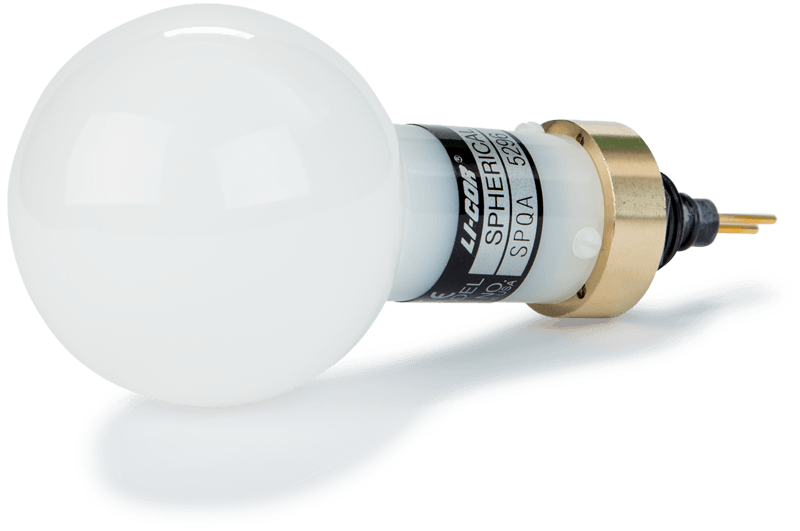
You'd be using a sensor something like this:
LI-193
Spherical Underwater Quantum Sensor
The LI-193 Spherical Quantum Sensor measures PAR in air or underwater from all directions at depths up to 350 meters. This sensor is useful for studies of phytoplankton, which uses radiation from all directions. The measurement is referred to as Photosynthetic Photon Flux Fluence Rate (PPFFR) or Quantum Scalar Irradiance.
In reality, when removing strong lenses you're lighting up the glass of your tank more and that glass is what's doing a lot of the reflecting. (Sand bed and anything else white too.)
It's likely that more algae will grow on the glass as a result, and that will impact the reflectivity. Upgrade you CUC and glass scraper if needed! :)
It's also glass and not a mirror (duh) so there's some loss of light through the glass during reflection....why you can see into the tank. :p :D
But if you measure that light coming
through the glass from the inside, I bet it accounts for almost all the "loss in PAR" between lenses and no-lenses if you could measure "all light" in the tank.
The point?
Corals are designed to make full use of scalar irradiance – which could hypothetically be a mixed blessing during a lens switch like this.
If you've taken a coral that had deep shade on it anywhere and by this lens swap have converted that deep shade area to "low light", that would be a huge increase in photosynthesis in a part of the coral that was adapted to shade. A part like that is likely to be relatively unshielded to light AND densely populated by Symbiodinium. This can be really rough on the coral, and bleaching would be the result....dino's expelled.
I wouldn't really worry as long as 1) flow is good, 2) nutrients in the system are positive (especially P) and 3) the rest of the coral is not responding similarly. Hopefully the bleached parts of the coral will be supported by the rest of the colony until those parts can adapt to the new light situation. The bleached parts are technically now safe from further damage due to "unprotected photosynthesis".