Randy's Tank and Learn Thread

Miami Reef

Reef Chem Enthusiast
View Badges
Joined
Sep 8, 2017
Messages
17,255
Reaction score
29,618
Location
Miami
Rating - 0%
0   0   0
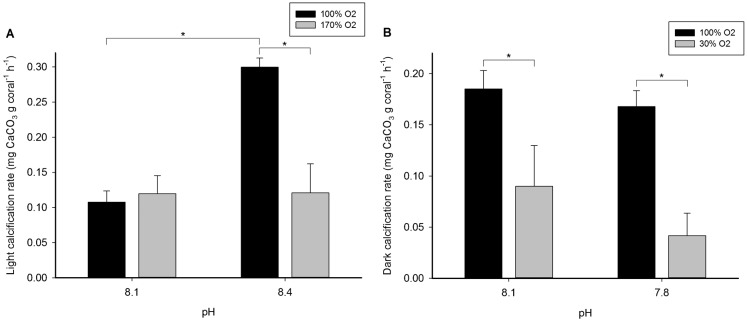
I’m no master, but since it’s late and I’m bored, I’ll give a sneak peak of ONE of the studies I’m referencing. Only 1. You will need to wait for the article to see the juicier ones.


IMG_2971.jpeg


For daytime (light calcification) acropora millepora’s growth rate increases by 178% when raising the pH from 8.1 to 8.4 as long as the oxygen saturation was at 100%. Hyperoxia (too much O₂ negated this benefit).


Howver, at night, the growth seems limited my oxygen rather than pH, noted by the graph on the right.


Are we leaving extra growth potential on the table if we let oxygen get too low at night???

Are people who use recirculating CO₂ scrubbers at night, to save money to raise pH, but lose the O₂ benefit from the skimmer, shooting themselves in the foot????

 

rishma

2500 Club Member
View Badges
Joined
Nov 15, 2009
Messages
2,757
Reaction score
2,500
Rating - 0%
0   0   0
I’m no master, but since it’s late and I’m bored, I’ll give a sneak peak of ONE of the studies I’m referencing. Only 1. You will need to wait for the article to see the juicier ones.


IMG_2971.jpeg


For daytime (light calcification) acropora millepora’s growth rate increases by 178% when raising the pH from 8.1 to 8.4 as long as the oxygen saturation was at 100%. Hyperoxia (too much O₂ negated this benefit).


Howver, at night, the growth seems limited my oxygen rather than pH, noted by the graph on the right.


Are we leaving extra growth potential on the table if we let oxygen get too low at night???

Are people who use recirculating CO₂ scrubbers at night, to save money to raise pH, but lose the O₂ benefit from the skimmer, shooting themselves in the foot????
I’ve never really thought about O2 saturation and how it might vary in a tank. Let me know if the following sounds right.

I assume 100% is tank water O2 in equilibrium with air.

Below 100% might occur due to respiration of bacteria, fish, algae (at night) consuming oxygen faster than its beings being replaced through gas exchange.

Above 100% could occur due to photosynthesis releasing oxygen into the water faster than it escapes to the air through gas exchange.

If I have that right….What’s interesting is high pH and elevated O2 saturation can be coincident. Same with low PH and low O2 saturation. True for most tanks anyway, recirculating scrubbers not withstanding.
 
Last edited:

Miami Reef

Reef Chem Enthusiast
View Badges
Joined
Sep 8, 2017
Messages
17,255
Reaction score
29,618
Location
Miami
Rating - 0%
0   0   0
I’ve never really thought about O2 saturation and how it might vary in a tank. Let me know if the following sounds right.

I assume 100% is tank water O2 in equilibrium with air.

Below 100% might occur due to respiration of bacteria, fish, algae (at night) consuming oxygen faster than its beings being replaced through gas exchange.

Above 100% could occur due to photosynthesis releasing oxygen into the water faster than it escapes to the air through gas exchange.

If I have that right….What’s interesting is high pH and elevated O2 saturation can be coincident. Same with low PH and low O2 saturation. True for most tanks anyway, recirculating scrubbers not withstanding.
If I’m not mistaken, I believe I read 75% is about the max after full equilibrium with ambient air, but I could be wrong.

During the day with enough photosynthesis might push it up a bit (no guarantee). Night tends to be lower, sometimes much lower.

There was a hobby study experimenting different tank sizes, variables, and O₂ levels. I can’t find it right now, but I just woke up. 🙂
 

rishma

2500 Club Member
View Badges
Joined
Nov 15, 2009
Messages
2,757
Reaction score
2,500
Rating - 0%
0   0   0
I’ve never really thought about O2 saturation and how it might vary in a tank. Let me know if the following sounds right.

I assume 100% is tank water O2 in equilibrium with air.

Below 100% might occur due to respiration of bacteria, fish, algae (at night) consuming oxygen faster than its beings being replaced through gas exchange.

Above 100% could occur due to photosynthesis releasing oxygen into the water faster than it escapes to the air through gas exchange.

If I have that right….What’s interesting is high pH and elevated O2 saturation can be coincident. Same with low PH and low O2 saturation. True for most tanks anyway, recirculating scrubbers not withstanding.
If I’m not mistaken, I believe I read 75% is about the max after full equilibrium with ambient air, but I could be wrong.

During the day with enough photosynthesis might push it up a bit. Night tends to be lower.

There was a hobby study experimenting different tank sizes, variables, and O₂ levels. I can’t find it right now, but I just woke up. 🙂
Hmmm. If it’s not percent of equilibrium oxygen solubility then 75% of what?

Good morning! ☕
 
OP
OP
Randy Holmes-Farley

Randy Holmes-Farley

Reef Chemist
View Badges
Joined
Sep 5, 2014
Messages
89,257
Reaction score
92,285
Location
Massachusetts, United States
Rating - 0%
0   0   0
100% would be saturation with normal air.

One other way that O2 (and CO2) and get higher than saturation is through pressurization, such as air injected below the surface, or even air bubbles that travel down. Could be even more significant if air bubbles are getting into a return pump. Mine has a fairly big head, and that compresses air bubbles, forcing the gas into the water ((if there are any bubbles in it, I’ve not seen any).
 
OP
OP
Randy Holmes-Farley

Randy Holmes-Farley

Reef Chemist
View Badges
Joined
Sep 5, 2014
Messages
89,257
Reaction score
92,285
Location
Massachusetts, United States
Rating - 0%
0   0   0
Elegance Emergency!

Got back this morning from being away for 4 days. All seems fine in tank until I notice the elegance is gone! Not sick, not dead, gone, skeleton and all.

Here’s what it looked like before I left (picture from July 17, but it looked the same until today).


IMG_3853.jpeg


I finally noticed some tentacles deep in the rocks. I took apart some of the rockwork to recover it.

Here’s where the mystery deepens. When it arrived about 10 weeks ago, it was a single skeleton. Pic below.
IMG_3304.jpeg


Now the piece I recovered contains what look like 3-4 separate skeletons. The skeletons are now each smaller than the original (I think), although it may have been the size of the right most skeleton in the picture below.

Did the skeleton break up into small pieces? Are some of them new skeletons entirely? How and why did it move? Current when expanded? Pulled (or pushed) by an organism? Maybe knocked out of place by a turbo snail or sea cucumber then caught be current?

Most important, what should I do now?

@dwest


IMG_3961.jpeg
 
Last edited:
OP
OP
Randy Holmes-Farley

Randy Holmes-Farley

Reef Chemist
View Badges
Joined
Sep 5, 2014
Messages
89,257
Reaction score
92,285
Location
Massachusetts, United States
Rating - 0%
0   0   0
Now that I look carefully at the picture blown up on my PC, the skeleton on the right may be one whole, and it may be similar or bigger than the original, with the two on the left being new "baby" skeletons.
 
OP
OP
Randy Holmes-Farley

Randy Holmes-Farley

Reef Chemist
View Badges
Joined
Sep 5, 2014
Messages
89,257
Reaction score
92,285
Location
Massachusetts, United States
Rating - 0%
0   0   0
Magnifica/Clown Update

The magnifica is doing very well. I decided to go for a trio of wild type ocellaris clowns from Dr Reef, which I just ordered. Hopefully, I will not end up with an outcast and a couple. :)

IMG_3967.jpeg
 
OP
OP
Randy Holmes-Farley

Randy Holmes-Farley

Reef Chemist
View Badges
Joined
Sep 5, 2014
Messages
89,257
Reaction score
92,285
Location
Massachusetts, United States
Rating - 0%
0   0   0
MIlka Stylo Update

I haven't given many updates on this coral, but it seems to be doing fine. Careful comparison of the today picture (directly below) and shortly after arrival (2 months ago; next picture down), shows a bit of growth at the tips, especially those at the top. The color difference (more blue now, more purple previously) may be real, or a slight difference in the lighting spectrum.

i don't need or particularly want this coral to get bigger, but it is certainly doing fine. In any case, I'm certainly happy with it. :)


IMG_3963.jpeg


IMG_3428.jpeg
 
Last edited:

areefer01

5000 Club Member
View Badges
Joined
Jun 28, 2021
Messages
5,667
Reaction score
5,883
Location
Ca
Rating - 0%
0   0   0
Did the skeleton break up into small pieces? Are some of them new skeletons entirely? How and why did it move? Current when expanded? Pulled (or pushed) by an organism? Maybe knocked out of place by a turbo snail or sea cucumber then caught be current?


IMG_3961.jpeg

The image you showed does not look damaged or broken. If it was I would expect the polyp cup to show signs of damage. Again the image does not show that. It looks like smooth, healthy, flesh to the coral skeleton base. Unless you are not showing that? I also do not see polyp bailout or signs of it removing itself from the skeleton. I don't remember if that is a "thing" with elegances though so may be a moot point.

I do not currently keep an Elegance and it has been a good while since I last did. Trying to think back at what mine looked like I recall it being a single skeleton with a large polyp / mouth vs many to one. I am not an elegance expert here so really not sure.

TL; DR the image you show the flesh looks good and no tears or crushed / broken skeleton. So all signs should point to a healthy cup, mouth, polyp.
 
OP
OP
Randy Holmes-Farley

Randy Holmes-Farley

Reef Chemist
View Badges
Joined
Sep 5, 2014
Messages
89,257
Reaction score
92,285
Location
Massachusetts, United States
Rating - 0%
0   0   0
Chemistry Update

Salinity: 35 ppt, 53 mS/cm, sg = 1.0264
pH 8.0 at 1 pm
Nitrate 10 ppm
Phosphate 0.32 ppm
Alk 8.5 dKH
Temp ~ 78 F

No change to AFR
No nutrients dosed
Iodine dosed to about 0.06 pom iodide
Ferrous gluconate dosed
manganese gluconate dosed
 
OP
OP
Randy Holmes-Farley

Randy Holmes-Farley

Reef Chemist
View Badges
Joined
Sep 5, 2014
Messages
89,257
Reaction score
92,285
Location
Massachusetts, United States
Rating - 0%
0   0   0
The image you showed does not look damaged or broken. If it was I would expect the polyp cup to show signs of damage. Again the image does not show that. It looks like smooth, healthy, flesh to the coral skeleton base. Unless you are not showing that? I also do not see polyp bailout or signs of it removing itself from the skeleton. I don't remember if that is a "thing" with elegances though so may be a moot point.

I do not currently keep an Elegance and it has been a good while since I last did. Trying to think back at what mine looked like I recall it being a single skeleton with a large polyp / mouth vs many to one. I am not an elegance expert here so really not sure.

TL; DR the image you show the flesh looks good and no tears or crushed / broken skeleton. So all signs should point to a healthy cup, mouth, polyp.

It is true that I do not see any damage. It may have grown these two new little skeletons in my tank, and perhaps the movement was unrelated to that aspect.

It is perking up nicely after recovering it from the cave:

image.jpg
 

X-37B

Fight The Good Fight
View Badges
Joined
Jul 3, 2017
Messages
14,075
Reaction score
23,049
Location
The Outer Limits
Rating - 0%
0   0   0
MIlka Stylo Update

I haven't given many updates an this coral, but it seems to be doing fine. Careful comparison of the today picture (directly below) and shortly after arrival (2 months ago; next picture down), shows a bit of growth at the tips, especially those at the top. The color difference (more blue now, more purple previously) may be real, or a slight difference in the lighting spectrum.

i don't need or particularly want this coral to get bigger, but it is certainly doing fine. In any case, I'm certainly happy with it. :)


IMG_3963.jpeg


IMG_3428.jpeg
Lol! That thing is going to get huge. Fragging in the future can keep it under control.
Yours is big now and we all know the bigger the coral the faster it grows.
I put this small frag in at the 1 month mark in my system and that's 1 year growth.
I have always found them to be weed like in growth in my systems.
Can't wait to see how big you let yours get.
20240722_134318.jpg
20250805_112325.jpg
 
Last edited:

dwest

2500 Club Member
View Badges
Joined
Feb 27, 2018
Messages
4,951
Reaction score
9,537
Location
Cincinnati
Rating - 0%
0   0   0
Elegance Emergency!

Got back this morning from being away for 4 days. All seems fine in tank until I notice the elegance is gone! Not sick, not dead, gone, skeleton and all.

Here’s what it looked like before I left (picture from July 17, but it looked the same until today).


IMG_3853.jpeg


I finally noticed some tentacles deep in the rocks. I took apart some of the rockwork to recover it.

Here’s where the mystery deepens. When it arrived about 10 weeks ago, it was a single skeleton. Pic below.
IMG_3304.jpeg


Now the piece I recovered contains what look like 3-4 separate skeletons. The skeletons are now each smaller than the original (I think), although it may have been the size of the right most skeleton in the picture below.

Did the skeleton break up into small pieces? Are some of them new skeletons entirely? How and why did it move? Current when expanded? Pulled (or pushed) by an organism? Maybe knocked out of place by a turbo snail or sea cucumber then caught be current?

Most important, what should I do now?

@dwest


IMG_3961.jpeg
That’s pretty cool Randy. I think if you can keep it in the light somehow everything will be fine.

I think there was only one base a few months ago. I’m wondering if it is dividing intentionally or its bases will fuse together as one. Who knows…

I wish there was a way to keep it held down but yet give its base room to expand. I failed trying that with a different offspring.

I think you know it’s parents was once one coral but is now three. But that process took 30 years.

Thanks for posting the updates. I am a frequent lurker.

Oh and I suspect crabs moved it. But once again, who knows…
 
OP
OP
Randy Holmes-Farley

Randy Holmes-Farley

Reef Chemist
View Badges
Joined
Sep 5, 2014
Messages
89,257
Reaction score
92,285
Location
Massachusetts, United States
Rating - 0%
0   0   0
That’s pretty cool Randy. I think if you can keep it in the light somehow everything will be fine.

I think there was only one base a few months ago. I’m wondering if it is dividing intentionally or its bases will fuse together as one. Who knows…

I wish there was a way to keep it held down but yet give its base room to expand. I failed trying that with a different offspring.

I think you know it’s parents was once one coral but is now three. But that process took 30 years.

Thanks for posting the updates. I am a frequent lurker.

Oh and I suspect crabs moved it. But once again, who knows…

Thanks. Crabs are certainly possible. There are three pretty good size crabs now (were small when they came in). :)

I Might try penning it it better with some loose rocks.
 

dwest

2500 Club Member
View Badges
Joined
Feb 27, 2018
Messages
4,951
Reaction score
9,537
Location
Cincinnati
Rating - 0%
0   0   0
Thanks. Crabs are certainly possible. There are three pretty good size crabs now (were small when they came in). :)

I Might try penning it it better with some loose rocks.
I was always amazed at the number and size of crabs after I trapped them 6 months or so after adding liverock. The tilted glass method is as good as any if you are interested in capturing them. I have a love hate relationship with with most crabs.

I bet if you can give the elegance light for another 6 months or so, it will be good to go. I’ve had what appears to be sexual reproduction a couple of times before. Yours has made it the farthest and you are almost out of the woods I believe.
 

jonelder68

Valuable Member
View Badges
Joined
Aug 13, 2023
Messages
1,700
Reaction score
2,388
Location
Olathe
Rating - 0%
0   0   0
Chemistry Update

Salinity: 35 ppt, 53 mS/cm, sg = 1.0264
pH 8.0 at 1 pm
Nitrate 10 ppm
Phosphate 0.32 ppm
Alk 8.5 dKH
Temp ~ 78 F

No change to AFR
No nutrients dosed
Iodine dosed to about 0.06 pom iodide
Ferrous gluconate dosed
manganese gluconate dosed
I remember you were talking about coming up with a trace element dosing recipe. Are you still considering one or are you content with just dosing iodine, iron, and manganese? Maybe plans changed since using AFR? A cheatogro Randy recipe be amazing! Or a tropic marine A & K recipe to add to our DIY dosing 😀 It’s the final
Equation to being fully DIY.
 
OP
OP
Randy Holmes-Farley

Randy Holmes-Farley

Reef Chemist
View Badges
Joined
Sep 5, 2014
Messages
89,257
Reaction score
92,285
Location
Massachusetts, United States
Rating - 0%
0   0   0
I remember you were talking about coming up with a trace element dosing recipe. Are you still considering one or are you content with just dosing iodine, iron, and manganese? Maybe plans changed since using AFR? A cheatogro Randy recipe be amazing! Or a tropic marine A & K recipe to add to our DIY dosing 😀 It’s the final
Equation to being fully DIY.

I hope to find time for that, but between dosing AFR, and extra iron, manganese and iodide (because of all the macroalgae) it isn’t a priority at the moment.

That said, I think everything in A and K is in the diy archive. It’s just a matter of rolling it all together.
 

jonelder68

Valuable Member
View Badges
Joined
Aug 13, 2023
Messages
1,700
Reaction score
2,388
Location
Olathe
Rating - 0%
0   0   0
I hope to find time for that, but between dosing AFR, and extra iron, manganese and iodide (because of all the macroalgae) it isn’t a priority at the moment.

That said, I think everything in A and K is in the diy archive. It’s just a matter of rolling it all together.
@Miami Reef your next project 😀. I’m to dumb for all that. Just need the recipe 🤣. Maybe when back from vacation I can further try and diagnose the mixture.
 

TOP 10 Trending Threads

WHAT AMOUNT OF LIVE ROCK AND SAND SHOULD BE PRIORITIZED FOR OPTIMAL BIODIVERSITY/FILTRATION?

  • 100% live rock + bagged sand

    Votes: 37 27.6%
  • 100% dry rock + 100% live sand

    Votes: 45 33.6%
  • 50/50 live/dry rock, 50/50 live/bagged sand

    Votes: 30 22.4%
  • 75% live rock, 25% live sand

    Votes: 12 9.0%
  • 25% live rock, 75% live sand

    Votes: 10 7.5%
Back
Top